Critics have remarked that those four worthies were truly peerless throughout the ages; yet the present falls short of the past—the ancients favored unadorned simplicity, whereas the moderns prefer refined elegance. Styles of substance and ornament rise and fall in succession, shifting with the changing mores of the times; such evolution is simply the natural order of things. The ideal lies in honoring antiquity without clashing with the present, and embracing modernity without succumbing to its flaws—embodying that perfect balance of substance and refinement that defines the true gentleman. There is surely no need to abandon a carved palace in favor of a cave dwelling, or to trade a jade carriage for a primitive cart with solid wooden wheels.🌌 SpectraShell
#!/usr/bin/perl -w
# -*- perl -*-
# Generated from bin/aclocal.in; do not edit by hand.

eval 'case $# in 0) exec /usr/bin/perl -S "$0";; *) exec /usr/bin/perl -S "$0" "$@";; esac'
    if 0;

# aclocal - create aclocal.m4 by scanning configure.ac

# Copyright (C) 1996-2018 Free Software Foundation, Inc.

# This program is free software; you can redistribute it and/or modify
# it under the terms of the GNU General Public License as published by
# the Free Software Foundation; either version 2, or (at your option)
# any later version.

# This program is distributed in the hope that it will be useful,
# but WITHOUT ANY WARRANTY; without even the implied warranty of
# MERCHANTABILITY or FITNESS FOR A PARTICULAR PURPOSE.  See the
# GNU General Public License for more details.

# You should have received a copy of the GNU General Public License
# along with this program.  If not, see <https://www.gnu.org/licenses/>.

# Written by Tom Tromey <tromey@redhat.com>, and
# Alexandre Duret-Lutz <adl@gnu.org>.

BEGIN
{
  unshift (@INC, '/usr/share/automake-1.16')
    unless $ENV{AUTOMAKE_UNINSTALLED};
}

use strict;

use Automake::Config;
use Automake::General;
use Automake::Configure_ac;
use Automake::Channels;
use Automake::ChannelDefs;
use Automake::XFile;
use Automake::FileUtils;
use File::Basename;
use File::Path ();

# Some globals.

# Support AC_CONFIG_MACRO_DIRS also with older autoconf.
# FIXME: To be removed in Automake 2.0, once we can assume autoconf
#        2.70 or later.
# FIXME: keep in sync with 'internal/ac-config-macro-dirs.m4'.
my $ac_config_macro_dirs_fallback =
  'm4_ifndef([AC_CONFIG_MACRO_DIRS], [' .
    'm4_defun([_AM_CONFIG_MACRO_DIRS], [])' .
    'm4_defun([AC_CONFIG_MACRO_DIRS], [_AM_CONFIG_MACRO_DIRS($@)])' .
  '])';

# We do not operate in threaded mode.
$perl_threads = 0;

# Include paths for searching macros.  We search macros in this order:
# user-supplied directories first, then the directory containing the
# automake macros, and finally the system-wide directories for
# third-party macros.
# @user_includes can be augmented with -I or AC_CONFIG_MACRO_DIRS.
# @automake_includes can be reset with the '--automake-acdir' option.
# @system_includes can be augmented with the 'dirlist' file or the
# ACLOCAL_PATH environment variable, and reset with the '--system-acdir'
# option.
my @user_includes = ();
my @automake_includes = ('/usr/share/aclocal-' . $APIVERSION);
my @system_includes = ('/usr/share/aclocal');

# Whether we should copy M4 file in $user_includes[0].
my $install = 0;

# --diff
my @diff_command;

# --dry-run
my $dry_run = 0;

# configure.ac or configure.in.
my $configure_ac;

# Output file name.
my $output_file = 'aclocal.m4';

# Option --force.
my $force_output = 0;

# Modification time of the youngest dependency.
my $greatest_mtime = 0;

# Which macros have been seen.
my %macro_seen = ();

# Remember the order into which we scanned the files.
# It's important to output the contents of aclocal.m4 in the opposite order.
# (Definitions in first files we have scanned should override those from
# later files.  So they must appear last in the output.)
my @file_order = ();

# Map macro names to file names.
my %map = ();

# Ditto, but records the last definition of each macro as returned by --trace.
my %map_traced_defs = ();

# Map basenames to macro names.
my %invmap = ();

# Map file names to file contents.
my %file_contents = ();

# Map file names to file types.
my %file_type = ();
use constant FT_USER => 1;
use constant FT_AUTOMAKE => 2;
use constant FT_SYSTEM => 3;

# Map file names to included files (transitively closed).
my %file_includes = ();

# Files which have already been added.
my %file_added = ();

# Files that have already been scanned.
my %scanned_configure_dep = ();

# Serial numbers, for files that have one.
# The key is the basename of the file,
# the value is the serial number represented as a list.
my %serial = ();

# Matches a macro definition.
#   AC_DEFUN([macroname], ...)
# or
#   AC_DEFUN(macroname, ...)
# When macroname is '['-quoted , we accept any character in the name,
# except ']'.  Otherwise macroname stops on the first ']', ',', ')',
# or '\n' encountered.
my $ac_defun_rx =
  "(?:AU_ALIAS|A[CU]_DEFUN|AC_DEFUN_ONCE)\\((?:\\[([^]]+)\\]|([^],)\n]+))";

# Matches an AC_REQUIRE line.
my $ac_require_rx = "AC_REQUIRE\\((?:\\[([^]]+)\\]|([^],)\n]+))\\)";

# Matches an m4_include line.
my $m4_include_rx = "(m4_|m4_s|s)include\\((?:\\[([^]]+)\\]|([^],)\n]+))\\)";

# Match a serial number.
my $serial_line_rx = '^#\s*serial\s+(\S*)';
my $serial_number_rx = '^\d+(?:\.\d+)*$';

# Autoconf version.  This variable is set by 'trace_used_macros'.
my $ac_version;

# User directory containing extra m4 files for macros definition,
# as extracted from calls to the macro AC_CONFIG_MACRO_DIRS.
# This variable is updated by 'trace_used_macros'.
my @ac_config_macro_dirs;

# If set, names a temporary file that must be erased on abnormal exit.
my $erase_me;

# Constants for the $ERR_LEVEL parameter of the 'scan_m4_dirs' function.
use constant SCAN_M4_DIRS_SILENT => 0;
use constant SCAN_M4_DIRS_WARN => 1;
use constant SCAN_M4_DIRS_ERROR => 2;

################################################################

# Prototypes for all subroutines.

sub add_file ($);
sub add_macro ($);
sub check_acinclude ();
sub install_file ($$);
sub list_compare (\@\@);
sub parse_ACLOCAL_PATH ();
sub parse_arguments ();
sub reset_maps ();
sub scan_configure ();
sub scan_configure_dep ($);
sub scan_file ($$$);
sub scan_m4_dirs ($$@);
sub scan_m4_files ();
sub strip_redundant_includes (%);
sub trace_used_macros ();
sub unlink_tmp (;$);
sub usage ($);
sub version ();
sub write_aclocal ($@);
sub xmkdir_p ($);

################################################################

# Erase temporary file ERASE_ME.  Handle signals.
sub unlink_tmp (;$)
{
  my ($sig) = @_;

  if ($sig)
    {
      verb "caught SIG$sig, bailing out";
    }
  if (defined $erase_me && -e $erase_me && !unlink ($erase_me))
    {
      fatal "could not remove '$erase_me': $!";
    }
  undef $erase_me;

  # reraise default handler.
  if ($sig)
    {
      $SIG{$sig} = 'DEFAULT';
      kill $sig => $$;
    }
}

$SIG{'INT'} = $SIG{'TERM'} = $SIG{'QUIT'} = $SIG{'HUP'} = 'unlink_tmp';
END { unlink_tmp }

sub xmkdir_p ($)
{
  my $dir = shift;
  local $@ = undef;
  return
    if -d $dir or eval { File::Path::mkpath $dir };
  chomp $@;
  $@ =~ s/\s+at\s.*\bline\s\d+.*$//;
  fatal "could not create directory '$dir': $@";
}

# Check macros in acinclude.m4.  If one is not used, warn.
sub check_acinclude ()
{
  foreach my $key (keys %map)
    {
      # FIXME: should print line number of acinclude.m4.
      msg ('syntax', "macro '$key' defined in acinclude.m4 but never used")
	if $map{$key} eq 'acinclude.m4' && ! exists $macro_seen{$key};
    }
}

sub reset_maps ()
{
  $greatest_mtime = 0;
  %macro_seen = ();
  @file_order = ();
  %map = ();
  %map_traced_defs = ();
  %file_contents = ();
  %file_type = ();
  %file_includes = ();
  %file_added = ();
  %scanned_configure_dep = ();
  %invmap = ();
  %serial = ();
  undef &search;
}

# install_file ($SRC, $DESTDIR)
sub install_file ($$)
{
  my ($src, $destdir) = @_;
  my $dest = $destdir . "/" . basename ($src);
  my $diff_dest;

  verb "installing $src to $dest";

  if ($force_output
      || !exists $file_contents{$dest}
      || $file_contents{$src} ne $file_contents{$dest})
    {
      if (-e $dest)
	{
	  msg 'note', "overwriting '$dest' with '$src'";
	  $diff_dest = $dest;
	}
      else
	{
	  msg 'note', "installing '$dest' from '$src'";
	}

      if (@diff_command)
	{
	  if (! defined $diff_dest)
	    {
	      # $dest does not exist.  We create an empty one just to
	      # run diff, and we erase it afterward.  Using the real
	      # the destination file (rather than a temporary file) is
	      # good when diff is run with options that display the
	      # file name.
	      #
	      # If creating $dest fails, fall back to /dev/null.  At
	      # least one diff implementation (Tru64's) cannot deal
	      # with /dev/null.  However working around this is not
	      # worth the trouble since nobody run aclocal on a
	      # read-only tree anyway.
	      $erase_me = $dest;
	      my $f = new IO::File "> $dest";
	      if (! defined $f)
		{
		  undef $erase_me;
		  $diff_dest = '/dev/null';
		}
	      else
		{
		  $diff_dest = $dest;
		  $f->close;
		}
	    }
	  my @cmd = (@diff_command, $diff_dest, $src);
	  $! = 0;
	  verb "running: @cmd";
	  my $res = system (@cmd);
	  Automake::FileUtils::handle_exec_errors "@cmd", 1
	    if $res;
	  unlink_tmp;
	}
      elsif (!$dry_run)
	{
          xmkdir_p ($destdir);
	  xsystem ('cp', $src, $dest);
	}
    }
}

# Compare two lists of numbers.
sub list_compare (\@\@)
{
  my @l = @{$_[0]};
  my @r = @{$_[1]};
  while (1)
    {
      if (0 == @l)
	{
	  return (0 == @r) ? 0 : -1;
	}
      elsif (0 == @r)
	{
	  return 1;
	}
      elsif ($l[0] < $r[0])
	{
	  return -1;
	}
      elsif ($l[0] > $r[0])
	{
	  return 1;
	}
      shift @l;
      shift @r;
    }
}

################################################################

# scan_m4_dirs($TYPE, $ERR_LEVEL, @DIRS)
# -----------------------------------------------
# Scan all M4 files installed in @DIRS for new macro definitions.
# Register each file as of type $TYPE (one of the FT_* constants).
# If a directory in @DIRS cannot be read:
#  - fail hard                if $ERR_LEVEL == SCAN_M4_DIRS_ERROR
#  - just print a warning     if $ERR_LEVEL == SCAN_M4_DIRS_WA
#  - continue silently        if $ERR_LEVEL == SCAN_M4_DIRS_SILENT
sub scan_m4_dirs ($$@)
{
  my ($type, $err_level, @dirlist) = @_;

  foreach my $m4dir (@dirlist)
    {
      if (! opendir (DIR, $m4dir))
	{
	  # TODO: maybe avoid complaining only if errno == ENONENT?
          my $message = "couldn't open directory '$m4dir': $!";

          if ($err_level == SCAN_M4_DIRS_ERROR)
            {
              fatal $message;
            }
          elsif ($err_level == SCAN_M4_DIRS_WARN)
            {
              msg ('unsupported', $message);
              next;
            }
          elsif ($err_level == SCAN_M4_DIRS_SILENT)
            {
              next; # Silently ignore.
            }
          else
            {
               prog_error "invalid \$err_level value '$err_level'";
            }
	}

      # We reverse the directory contents so that foo2.m4 gets
      # used in preference to foo1.m4.
      foreach my $file (reverse sort grep (! /^\./, readdir (DIR)))
	{
	  # Only examine .m4 files.
	  next unless $file =~ /\.m4$/;

	  # Skip some files when running out of srcdir.
	  next if $file eq 'aclocal.m4';

	  my $fullfile = File::Spec->canonpath ("$m4dir/$file");
	  scan_file ($type, $fullfile, 'aclocal');
	}
      closedir (DIR);
    }
}

# Scan all the installed m4 files and construct a map.
sub scan_m4_files ()
{
  # First, scan configure.ac.  It may contain macro definitions,
  # or may include other files that define macros.
  scan_file (FT_USER, $configure_ac, 'aclocal');

  # Then, scan acinclude.m4 if it exists.
  if (-f 'acinclude.m4')
    {
      scan_file (FT_USER, 'acinclude.m4', 'aclocal');
    }

  # Finally, scan all files in our search paths.

  if (@user_includes)
    {
      # Don't explore the same directory multiple times.  This is here not
      # only for speedup purposes.  We need this when the user has e.g.
      # specified 'ACLOCAL_AMFLAGS = -I m4' and has also set
      # AC_CONFIG_MACRO_DIR[S]([m4]) in configure.ac.  This makes the 'm4'
      # directory to occur twice here and fail on the second call to
      # scan_m4_dirs([m4]) when the 'm4' directory doesn't exist.
      # TODO: Shouldn't there be rather a check in scan_m4_dirs for
      #       @user_includes[0]?
      @user_includes = uniq @user_includes;

      # Don't complain if the first user directory doesn't exist, in case
      # we need to create it later (can happen if '--install' was given).
      scan_m4_dirs (FT_USER,
                    $install ? SCAN_M4_DIRS_SILENT : SCAN_M4_DIRS_WARN,
                    $user_includes[0]);
      scan_m4_dirs (FT_USER,
                    SCAN_M4_DIRS_ERROR,
		    @user_includes[1..$#user_includes]);
    }
  scan_m4_dirs (FT_AUTOMAKE, SCAN_M4_DIRS_ERROR, @automake_includes);
  scan_m4_dirs (FT_SYSTEM, SCAN_M4_DIRS_ERROR, @system_includes);

  # Construct a new function that does the searching.  We use a
  # function (instead of just evaluating $search in the loop) so that
  # "die" is correctly and easily propagated if run.
  my $search = "sub search {\nmy \$found = 0;\n";
  foreach my $key (reverse sort keys %map)
    {
      $search .= ('if (/\b\Q' . $key . '\E(?!\w)/) { add_macro ("' . $key
		  . '"); $found = 1; }' . "\n");
    }
  $search .= "return \$found;\n};\n";
  eval $search;
  prog_error "$@\n search is $search" if $@;
}

################################################################

# Add a macro to the output.
sub add_macro ($)
{
  my ($macro) = @_;

  # Ignore unknown required macros.  Either they are not really
  # needed (e.g., a conditional AC_REQUIRE), in which case aclocal
  # should be quiet, or they are needed and Autoconf itself will
  # complain when we trace for macro usage later.
  return unless defined $map{$macro};

  verb "saw macro $macro";
  $macro_seen{$macro} = 1;
  add_file ($map{$macro});
}

# scan_configure_dep ($file)
# --------------------------
# Scan a configure dependency (configure.ac, or separate m4 files)
# for uses of known macros and AC_REQUIREs of possibly unknown macros.
# Recursively scan m4_included files.
sub scan_configure_dep ($)
{
  my ($file) = @_;
  # Do not scan a file twice.
  return ()
    if exists $scanned_configure_dep{$file};
  $scanned_configure_dep{$file} = 1;

  my $mtime = mtime $file;
  $greatest_mtime = $mtime if $greatest_mtime < $mtime;

  my $contents = exists $file_contents{$file} ?
    $file_contents{$file} : contents $file;

  my $line = 0;
  my @rlist = ();
  my @ilist = ();
  foreach (split ("\n", $contents))
    {
      ++$line;
      # Remove comments from current line.
      s/\bdnl\b.*$//;
      s/\#.*$//;
      # Avoid running all the following regexes on white lines.
      next if /^\s*$/;

      while (/$m4_include_rx/go)
	{
	  my $ifile = $2 || $3;
	  # Skip missing 'sinclude'd files.
	  next if $1 ne 'm4_' && ! -f $ifile;
	  push @ilist, $ifile;
	}

      while (/$ac_require_rx/go)
	{
	  push (@rlist, $1 || $2);
	}

      # The search function is constructed dynamically by
      # scan_m4_files.  The last parenthetical match makes sure we
      # don't match things that look like macro assignments or
      # AC_SUBSTs.
      if (! &search && /(^|\s+)(AM_[A-Z0-9_]+)($|[^\]\)=A-Z0-9_])/)
	{
	  # Macro not found, but AM_ prefix found.
	  # Make this just a warning, because we do not know whether
	  # the macro is actually used (it could be called conditionally).
	  msg ('unsupported', "$file:$line",
	       "macro '$2' not found in library");
	}
    }

  add_macro ($_) foreach (@rlist);
  scan_configure_dep ($_) foreach @ilist;
}

# add_file ($FILE)
# ----------------
# Add $FILE to output.
sub add_file ($)
{
  my ($file) = @_;

  # Only add a file once.
  return if ($file_added{$file});
  $file_added{$file} = 1;

  scan_configure_dep $file;
}

# Point to the documentation for underquoted AC_DEFUN only once.
my $underquoted_manual_once = 0;

# scan_file ($TYPE, $FILE, $WHERE)
# --------------------------------
# Scan a single M4 file ($FILE), and all files it includes.
# Return the list of included files.
# $TYPE is one of FT_USER, FT_AUTOMAKE, or FT_SYSTEM, depending
# on where the file comes from.
# $WHERE is the location to use in the diagnostic if the file
# does not exist.
sub scan_file ($$$)
{
  my ($type, $file, $where) = @_;
  my $basename = basename $file;

  # Do not scan the same file twice.
  return @{$file_includes{$file}} if exists $file_includes{$file};
  # Prevent potential infinite recursion (if two files include each other).
  return () if exists $file_contents{$file};

  unshift @file_order, $file;

  $file_type{$file} = $type;

  fatal "$where: file '$file' does not exist" if ! -e $file;

  my $fh = new Automake::XFile $file;
  my $contents = '';
  my @inc_files = ();
  my %inc_lines = ();

  my $defun_seen = 0;
  my $serial_seen = 0;
  my $serial_older = 0;

  while ($_ = $fh->getline)
    {
      # Ignore '##' lines.
      next if /^##/;

      $contents .= $_;
      my $line = $_;

      if ($line =~ /$serial_line_rx/go)
	{
	  my $number = $1;
	  if ($number !~ /$serial_number_rx/go)
	    {
	      msg ('syntax', "$file:$.",
		   "ill-formed serial number '$number', "
		   . "expecting a version string with only digits and dots");
	    }
	  elsif ($defun_seen)
	    {
	      # aclocal removes all definitions from M4 file with the
	      # same basename if a greater serial number is found.
	      # Encountering a serial after some macros will undefine
	      # these macros...
	      msg ('syntax', "$file:$.",
		   'the serial number must appear before any macro definition');
	    }
	  # We really care about serials only for non-automake macros
	  # and when --install is used.  But the above diagnostics are
	  # made regardless of this, because not using --install is
	  # not a reason not the fix macro files.
	  elsif ($install && $type != FT_AUTOMAKE)
	    {
	      $serial_seen = 1;
	      my @new = split (/\./, $number);

	      verb "$file:$.: serial $number";

	      if (!exists $serial{$basename}
		  || list_compare (@new, @{$serial{$basename}}) > 0)
		{
		  # Delete any definition we knew from the old macro.
		  foreach my $def (@{$invmap{$basename}})
		    {
		      verb "$file:$.: ignoring previous definition of $def";
		      delete $map{$def};
		    }
		  $invmap{$basename} = [];
		  $serial{$basename} = \@new;
		}
	      else
		{
		  $serial_older = 1;
		}
	    }
	}

      # Remove comments from current line.
      # Do not do it earlier, because the serial line is a comment.
      $line =~ s/\bdnl\b.*$//;
      $line =~ s/\#.*$//;

      while ($line =~ /$ac_defun_rx/go)
	{
	  $defun_seen = 1;
	  if (! defined $1)
	    {
	      msg ('syntax', "$file:$.", "underquoted definition of $2"
		   . "\n  run info Automake 'Extending aclocal'\n"
		   . "  or see https://www.gnu.org/software/automake/manual/"
		   . "automake.html#Extending-aclocal")
		unless $underquoted_manual_once;
	      $underquoted_manual_once = 1;
	    }

	  # If this macro does not have a serial and we have already
	  # seen a macro with the same basename earlier, we should
	  # ignore the macro (don't exit immediately so we can still
	  # diagnose later #serial numbers and underquoted macros).
	  $serial_older ||= ($type != FT_AUTOMAKE
			     && !$serial_seen && exists $serial{$basename});

	  my $macro = $1 || $2;
	  if (!$serial_older && !defined $map{$macro})
	    {
	      verb "found macro $macro in $file: $.";
	      $map{$macro} = $file;
	      push @{$invmap{$basename}}, $macro;
	    }
	  else
	    {
	      # Note: we used to give an error here if we saw a
	      # duplicated macro.  However, this turns out to be
	      # extremely unpopular.  It causes actual problems which
	      # are hard to work around, especially when you must
	      # mix-and-match tool versions.
	      verb "ignoring macro $macro in $file: $.";
	    }
	}

      while ($line =~ /$m4_include_rx/go)
	{
	  my $ifile = $2 || $3;
	  # Skip missing 'sinclude'd files.
	  next if $1 ne 'm4_' && ! -f $ifile;
	  push (@inc_files, $ifile);
	  $inc_lines{$ifile} = $.;
	}
    }

  # Ignore any file that has an old serial (or no serial if we know
  # another one with a serial).
  return ()
    if ($serial_older ||
	($type != FT_AUTOMAKE && !$serial_seen && exists $serial{$basename}));

  $file_contents{$file} = $contents;

  # For some reason I don't understand, it does not work
  # to do "map { scan_file ($_, ...) } @inc_files" below.
  # With Perl 5.8.2 it undefines @inc_files.
  my @copy = @inc_files;
  my @all_inc_files = (@inc_files,
		       map { scan_file ($type, $_,
					"$file:$inc_lines{$_}") } @copy);
  $file_includes{$file} = \@all_inc_files;
  return @all_inc_files;
}

# strip_redundant_includes (%FILES)
# ---------------------------------
# Each key in %FILES is a file that must be present in the output.
# However some of these files might already include other files in %FILES,
# so there is no point in including them another time.
# This removes items of %FILES which are already included by another file.
sub strip_redundant_includes (%)
{
  my %files = @_;

  # Always include acinclude.m4, even if it does not appear to be used.
  $files{'acinclude.m4'} = 1 if -f 'acinclude.m4';
  # File included by $configure_ac are redundant.
  $files{$configure_ac} = 1;

  # Files at the end of @file_order should override those at the beginning,
  # so it is important to preserve these trailing files.  We can remove
  # a file A if it is going to be output before a file B that includes
  # file A, not the converse.
  foreach my $file (reverse @file_order)
    {
      next unless exists $files{$file};
      foreach my $ifile (@{$file_includes{$file}})
	{
	  next unless exists $files{$ifile};
	  delete $files{$ifile};
	  verb "$ifile is already included by $file";
	}
    }

  # configure.ac is implicitly included.
  delete $files{$configure_ac};

  return %files;
}

sub trace_used_macros ()
{
  my %files = map { $map{$_} => 1 } keys %macro_seen;
  %files = strip_redundant_includes %files;

  # When AC_CONFIG_MACRO_DIRS is used, avoid possible spurious warnings
  # from autom4te about macros being "m4_require'd but not m4_defun'd";
  # for more background, see:
  # https://lists.gnu.org/archive/html/autoconf-patches/2012-11/msg00004.html
  # as well as autoconf commit 'v2.69-44-g1ed0548', "warn: allow aclocal
  # to silence m4_require warnings".
  my $early_m4_code .= "m4_define([m4_require_silent_probe], [-])";

  my $traces = ($ENV{AUTOM4TE} || 'autom4te');
  $traces .= " --language Autoconf-without-aclocal-m4 ";
  $traces = "echo '$early_m4_code' | $traces - ";

  # Support AC_CONFIG_MACRO_DIRS also with older autoconf.
  # Note that we can't use '$ac_config_macro_dirs_fallback' here, because
  # a bug in option parsing code of autom4te 2.68 and earlier will cause
  # it to read standard input last, even if the "-" argument is specified
  # early.
  # FIXME: To be removed in Automake 2.0, once we can assume autoconf
  #        2.70 or later.
  $traces .= "$automake_includes[0]/internal/ac-config-macro-dirs.m4 ";

  # All candidate files.
  $traces .= join (' ',
		   (map { "'$_'" }
		    (grep { exists $files{$_} } @file_order))) . " ";

  # All candidate macros.
  $traces .= join (' ',
		   (map { "--trace='$_:\$f::\$n::\${::}%'" }
		    ('AC_DEFUN',
		     'AC_DEFUN_ONCE',
		     'AU_DEFUN',
		     '_AM_AUTOCONF_VERSION',
		     'AC_CONFIG_MACRO_DIR_TRACE',
                     # FIXME: Tracing the next two macros is a hack for
                     # compatibility with older autoconf.  Remove this in
                     # Automake 2.0, when we can assume Autoconf 2.70 or
                     # later.
		     'AC_CONFIG_MACRO_DIR',
		     '_AM_CONFIG_MACRO_DIRS')),
		   # Do not trace $1 for all other macros as we do
		   # not need it and it might contains harmful
		   # characters (like newlines).
		   (map { "--trace='$_:\$f::\$n'" } (keys %macro_seen)));

  verb "running $traces $configure_ac";

  my $tracefh = new Automake::XFile ("$traces $configure_ac |");

  @ac_config_macro_dirs = ();

  my %traced = ();

  while ($_ = $tracefh->getline)
    {
      chomp;
      my ($file, $macro, $arg1) = split (/::/);

      $traced{$macro} = 1 if exists $macro_seen{$macro};

      if ($macro eq 'AC_DEFUN' || $macro eq 'AC_DEFUN_ONCE'
            || $macro eq 'AU_DEFUN')
        {
          $map_traced_defs{$arg1} = $file;
        }
      elsif ($macro eq '_AM_AUTOCONF_VERSION')
        {
          $ac_version = $arg1;
        }
      elsif ($macro eq 'AC_CONFIG_MACRO_DIR_TRACE')
        {
          push @ac_config_macro_dirs, $arg1;
        }
      # FIXME: We still need to trace AC_CONFIG_MACRO_DIR
      # for compatibility with older autoconf.  Remove this
      # once we can assume Autoconf 2.70 or later.
      elsif ($macro eq 'AC_CONFIG_MACRO_DIR')
        {
          @ac_config_macro_dirs = ($arg1);
        }
      # FIXME:This is an hack for compatibility with older autoconf.
      # Remove this once we can assume Autoconf 2.70 or later.
      elsif ($macro eq '_AM_CONFIG_MACRO_DIRS')
        {
           # Empty leading/trailing fields might be produced by split,
           # hence the grep is really needed.
           push @ac_config_macro_dirs, grep (/./, (split /\s+/, $arg1));
        }
    }

  # FIXME: in Autoconf >= 2.70, AC_CONFIG_MACRO_DIR calls
  # AC_CONFIG_MACRO_DIR_TRACE behind the scenes, which could
  # leave unwanted duplicates in @ac_config_macro_dirs.
  # Remove this in Automake 2.0, when we'll stop tracing
  # AC_CONFIG_MACRO_DIR explicitly.
  @ac_config_macro_dirs = uniq @ac_config_macro_dirs;

  $tracefh->close;

  return %traced;
}

sub scan_configure ()
{
  # Make sure we include acinclude.m4 if it exists.
  if (-f 'acinclude.m4')
    {
      add_file ('acinclude.m4');
    }
  scan_configure_dep ($configure_ac);
}

################################################################

# Write output.
# Return 0 iff some files were installed locally.
sub write_aclocal ($@)
{
  my ($output_file, @macros) = @_;
  my $output = '';

  my %files = ();
  # Get the list of files containing definitions for the macros used.
  # (Filter out unused macro definitions with $map_traced_defs.  This
  # can happen when an Autoconf macro is conditionally defined:
  # aclocal sees the potential definition, but this definition is
  # actually never processed and the Autoconf implementation is used
  # instead.)
  for my $m (@macros)
    {
      $files{$map{$m}} = 1
	if (exists $map_traced_defs{$m}
	    && $map{$m} eq $map_traced_defs{$m});
    }
  # Do not explicitly include a file that is already indirectly included.
  %files = strip_redundant_includes %files;

  my $installed = 0;

  for my $file (grep { exists $files{$_} } @file_order)
    {
      # Check the time stamp of this file, and of all files it includes.
      for my $ifile ($file, @{$file_includes{$file}})
	{
	  my $mtime = mtime $ifile;
	  $greatest_mtime = $mtime if $greatest_mtime < $mtime;
	}

      # If the file to add looks like outside the project, copy it
      # to the output.  The regex catches filenames starting with
      # things like '/', '\', or 'c:\'.
      if ($file_type{$file} != FT_USER
	  || $file =~ m,^(?:\w:)?[\\/],)
	{
	  if (!$install || $file_type{$file} != FT_SYSTEM)
	    {
	      # Copy the file into aclocal.m4.
	      $output .= $file_contents{$file} . "\n";
	    }
	  else
	    {
	      # Install the file (and any file it includes).
	      my $dest;
	      for my $ifile (@{$file_includes{$file}}, $file)
		{
		  install_file ($ifile, $user_includes[0]);
		}
	      $installed = 1;
	    }
	}
      else
	{
	  # Otherwise, simply include the file.
	  $output .= "m4_include([$file])\n";
	}
    }

  if ($installed)
    {
      verb "running aclocal anew, because some files were installed locally";
      return 0;
    }

  # Nothing to output?!
  # FIXME: Shouldn't we diagnose this?
  return 1 if ! length ($output);

  if ($ac_version)
    {
      # Do not use "$output_file" here for the same reason we do not
      # use it in the header below.  autom4te will output the name of
      # the file in the diagnostic anyway.
      $output = "m4_ifndef([AC_AUTOCONF_VERSION],
  [m4_copy([m4_PACKAGE_VERSION], [AC_AUTOCONF_VERSION])])dnl
m4_if(m4_defn([AC_AUTOCONF_VERSION]), [$ac_version],,
[m4_warning([this file was generated for autoconf $ac_version.
You have another version of autoconf.  It may work, but is not guaranteed to.
If you have problems, you may need to regenerate the build system entirely.
To do so, use the procedure documented by the package, typically 'autoreconf'.])])

$output";
    }

  # We used to print "# $output_file generated automatically etc."  But
  # this creates spurious differences when using autoreconf.  Autoreconf
  # creates aclocal.m4t and then rename it to aclocal.m4, but the
  # rebuild rules generated by Automake create aclocal.m4 directly --
  # this would gives two ways to get the same file, with a different
  # name in the header.
  $output = "# generated automatically by aclocal $VERSION -*- Autoconf -*-

# Copyright (C) 1996-$RELEASE_YEAR Free Software Foundation, Inc.

# This file is free software; the Free Software Foundation
# gives unlimited permission to copy and/or distribute it,
# with or without modifications, as long as this notice is preserved.

# This program is distributed in the hope that it will be useful,
# but WITHOUT ANY WARRANTY, to the extent permitted by law; without
# even the implied warranty of MERCHANTABILITY or FITNESS FOR A
# PARTICULAR PURPOSE.

$ac_config_macro_dirs_fallback
$output";

  # We try not to update $output_file unless necessary, because
  # doing so invalidate Autom4te's cache and therefore slows down
  # tools called after aclocal.
  #
  # We need to overwrite $output_file in the following situations.
  #   * The --force option is in use.
  #   * One of the dependencies is younger.
  #     (Not updating $output_file in this situation would cause
  #     make to call aclocal in loop.)
  #   * The contents of the current file are different from what
  #     we have computed.
  if (!$force_output
      && $greatest_mtime < mtime ($output_file)
      && $output eq contents ($output_file))
    {
      verb "$output_file unchanged";
      return 1;
    }

  verb "writing $output_file";

  if (!$dry_run)
    {
      if (-e $output_file && !unlink $output_file)
        {
	  fatal "could not remove '$output_file': $!";
	}
      my $out = new Automake::XFile "> $output_file";
      print $out $output;
    }
  return 1;
}

################################################################

# Print usage and exit.
sub usage ($)
{
  my ($status) = @_;

  print <<'EOF';
Usage: aclocal [OPTION]...

Generate 'aclocal.m4' by scanning 'configure.ac' or 'configure.in'

Options:
      --automake-acdir=DIR  directory holding automake-provided m4 files
      --system-acdir=DIR    directory holding third-party system-wide files
      --diff[=COMMAND]      run COMMAND [diff -u] on M4 files that would be
                            changed (implies --install and --dry-run)
      --dry-run             pretend to, but do not actually update any file
      --force               always update output file
      --help                print this help, then exit
  -I DIR                    add directory to search list for .m4 files
      --install             copy third-party files to the first -I directory
      --output=FILE         put output in FILE (default aclocal.m4)
      --print-ac-dir        print name of directory holding system-wide
                              third-party m4 files, then exit
      --verbose             don't be silent
      --version             print version number, then exit
  -W, --warnings=CATEGORY   report the warnings falling in CATEGORY

Warning categories include:
  syntax        dubious syntactic constructs (default)
  unsupported   unknown macros (default)
  all           all the warnings (default)
  no-CATEGORY   turn off warnings in CATEGORY
  none          turn off all the warnings
  error         treat warnings as errors

Report bugs to <bug-automake@gnu.org>.
GNU Automake home page: <http://www.gnu.org/software/automake/>.
General help using GNU software: <https://www.gnu.org/gethelp/>.
EOF
  exit $status;
}

# Print version and exit.
sub version ()
{
  print <<EOF;
aclocal (GNU $PACKAGE) $VERSION
Copyright (C) $RELEASE_YEAR Free Software Foundation, Inc.
License GPLv2+: GNU GPL version 2 or later <https://gnu.org/licenses/gpl-2.0.html>
This is free software: you are free to change and redistribute it.
There is NO WARRANTY, to the extent permitted by law.

Written by Tom Tromey <tromey\@redhat.com>
       and Alexandre Duret-Lutz <adl\@gnu.org>.
EOF
  exit 0;
}

# Parse command line.
sub parse_arguments ()
{
  my $print_and_exit = 0;
  my $diff_command;

  my %cli_options =
    (
     'help'		=> sub { usage(0); },
     'version'		=> \&version,
     'system-acdir=s'	=> sub { shift; @system_includes = @_; },
     'automake-acdir=s'	=> sub { shift; @automake_includes = @_; },
     'diff:s'		=> \$diff_command,
     'dry-run'		=> \$dry_run,
     'force'		=> \$force_output,
     'I=s'		=> \@user_includes,
     'install'          => \$install,
     'output=s'		=> \$output_file,
     'print-ac-dir'     => \$print_and_exit,
     'verbose'		=> sub { setup_channel 'verb', silent => 0; },
     'W|warnings=s'     => \&parse_warnings,
     );

  use Automake::Getopt ();
  Automake::Getopt::parse_options %cli_options;

  if (@ARGV > 0)
    {
      fatal ("non-option arguments are not accepted: '$ARGV[0]'.\n"
             . "Try '$0 --help' for more information.");
    }

  if ($print_and_exit)
    {
      print "@system_includes\n";
      exit 0;
    }

  if (defined $diff_command)
    {
      $diff_command = 'diff -u' if $diff_command eq '';
      @diff_command = split (' ', $diff_command);
      $install = 1;
      $dry_run = 1;
    }

  # Finally, adds any directory listed in the 'dirlist' file.
  if (@system_includes && open (DIRLIST, "$system_includes[0]/dirlist"))
    {
      while (<DIRLIST>)
        {
          # Ignore '#' lines.
          next if /^#/;
          # strip off newlines and end-of-line comments
          s/\s*\#.*$//;
          chomp;
          foreach my $dir (glob)
            {
              push (@system_includes, $dir) if -d $dir;
            }
        }
      close (DIRLIST);
    }
}

# Add any directory listed in the 'ACLOCAL_PATH' environment variable
# to the list of system include directories.
sub parse_ACLOCAL_PATH ()
{
  return if not defined $ENV{"ACLOCAL_PATH"};
  # Directories in ACLOCAL_PATH should take precedence over system
  # directories, so we use unshift.  However, directories that
  # come first in ACLOCAL_PATH take precedence over directories
  # coming later, which is why the result of split is reversed.
  foreach my $dir (reverse split /:/, $ENV{"ACLOCAL_PATH"})
    {
      unshift (@system_includes, $dir) if $dir ne '' && -d $dir;
    }
}

################################################################

# Don't refer to installation directories from the build environment
if (exists $ENV{"AUTOMAKE_UNINSTALLED"})
  {
    @automake_includes = ();
    @system_includes = ();
  }

@automake_includes = ($ENV{"ACLOCAL_AUTOMAKE_DIR"})
  if (exists $ENV{"ACLOCAL_AUTOMAKE_DIR"});

parse_WARNINGS;		    # Parse the WARNINGS environment variable.
parse_arguments;
parse_ACLOCAL_PATH;
$configure_ac = require_configure_ac;

# We may have to rerun aclocal if some file have been installed, but
# it should not happen more than once.  The reason we must run again
# is that once the file has been moved from /usr/share/aclocal/ to the
# local m4/ directory it appears at a new place in the search path,
# hence it should be output at a different position in aclocal.m4.  If
# we did not rerun aclocal, the next run of aclocal would produce a
# different aclocal.m4.
my $loop = 0;
my $rerun_due_to_macrodir = 0;
while (1)
  {
    ++$loop;
    prog_error "too many loops" if $loop > 2 + $rerun_due_to_macrodir;

    reset_maps;
    scan_m4_files;
    scan_configure;
    last if $exit_code;
    my %macro_traced = trace_used_macros;

    if (!$rerun_due_to_macrodir && @ac_config_macro_dirs)
      {
        # The directory specified in calls to the AC_CONFIG_MACRO_DIRS
        # m4 macro (if any) must go after the user includes specified
        # explicitly with the '-I' option.
        push @user_includes, @ac_config_macro_dirs;
        # We might have to scan some new directory of .m4 files.
        $rerun_due_to_macrodir++;
        next;
      }

    if ($install && !@user_includes)
      {
        fatal "installation of third-party macros impossible without " .
              "-I options nor AC_CONFIG_MACRO_DIR{,S} m4 macro(s)";
      }

    last if write_aclocal ($output_file, keys %macro_traced);
    last if $dry_run;
  }
check_acinclude;

exit $exit_code;
We have trained our AI Chat Bots with the knowledge of industry experts and conversion experts so you can be sure it knows how to do its job and answer all your questions instantly and provide requested information
AI Content Generation
Create amazing content 10X faster
Wordfairy can help you with a variety of writing tasks, from writing blog post, creating better resumes and job descriptions to composing emails and social media content, and many more. With 70+ templates, we can save you time and improve your writing skills.
AI Image Creation
Use AI to create any art or image
Are you looking for a tool to help you create unique beautiful artwork and images quickly and easily? Look no further! Our AI-powered software makes it simple to generate high-quality art and images with just a few clicks. With our intuitive interface and powerful technology, you can create stunning visuals in minutes instead of hours.
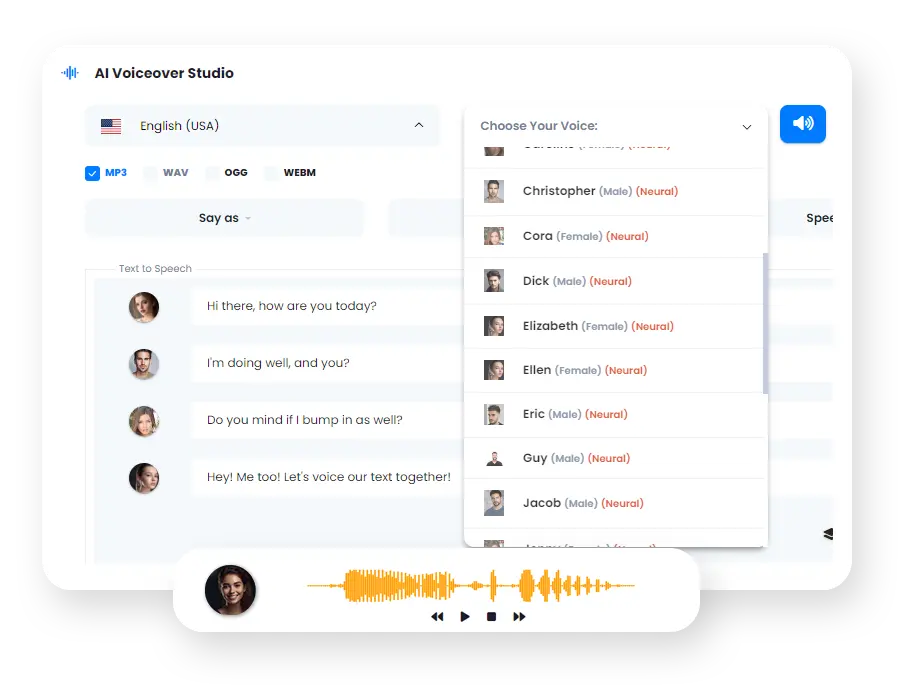
AI Voiceover Synthesize
Make studio-quality voiceovers in minutes
Truly human emotions in every voice over generated, breathing life into your voice overs. Our AI voices have elements that make a voice sound NATURAL and have all the expressions and tone inflections that are needed to make people more engaged in your content
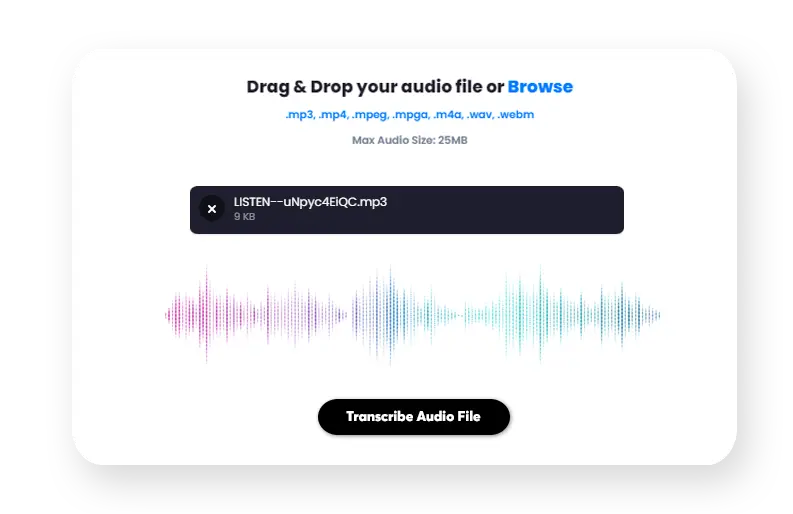
AI Speech to Text Transcribe
Transcribe accurately your audio
Accurately transcribe audio content in various formats. Enable transcription of your audio files in multiple languages, as well as translation from those languages into English.
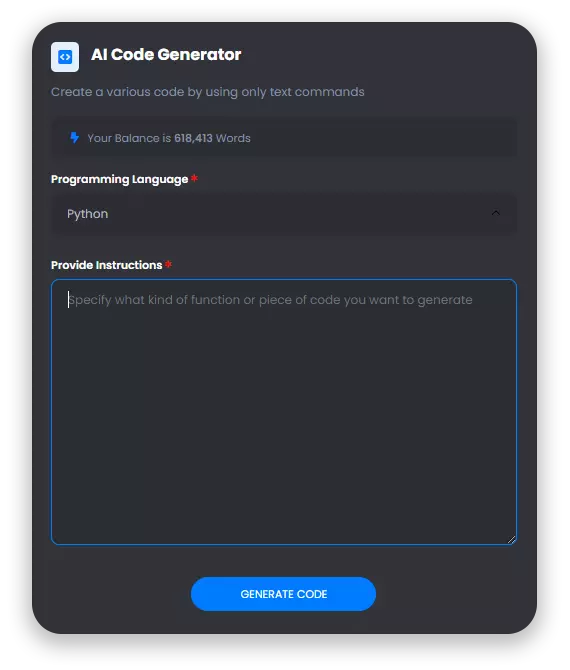
AI Code Generation
Write code like a Pro
Generate complex algorithms simply by using natural language to explain what you are after, we will take care rest for you. Write code like Pro in Python, Flutter, PHP, JavaScript, Ruby and other programming languages.
Think Big, Task Easy
Customers Using Incus Have Experienced:
90%
Time Reduced In Task
4x
Increase In Visibility
60%
Increase In Revenue
Select a Task
Choose from a variety of writing skills trained on industry best-practices
Ads
Create ads much faster and be more creative
Clickbait Titles
Create a creative clickbait titles for your products
Pro
Ad Headlines
Write an attention grabbing ad headlines
Blog Posts
Content for the generating articles, blog post
Blog Titles
Nobody wants to read boring blog titles, generate catchy blog titles with this tool
Blog Section
Write a full blog section (few paragraphs) about a subheading of your article
Blog Ideas
The perfect tool to start writing great articles. Generate creative ideas for your next post
Blog Intros
Write an intro that will entice your visitors to read more about your article
Blog Conclusion
End your blog articles with an engaging conclusion paragraph
Contents
Tools for writing creatives for different moods and tasks
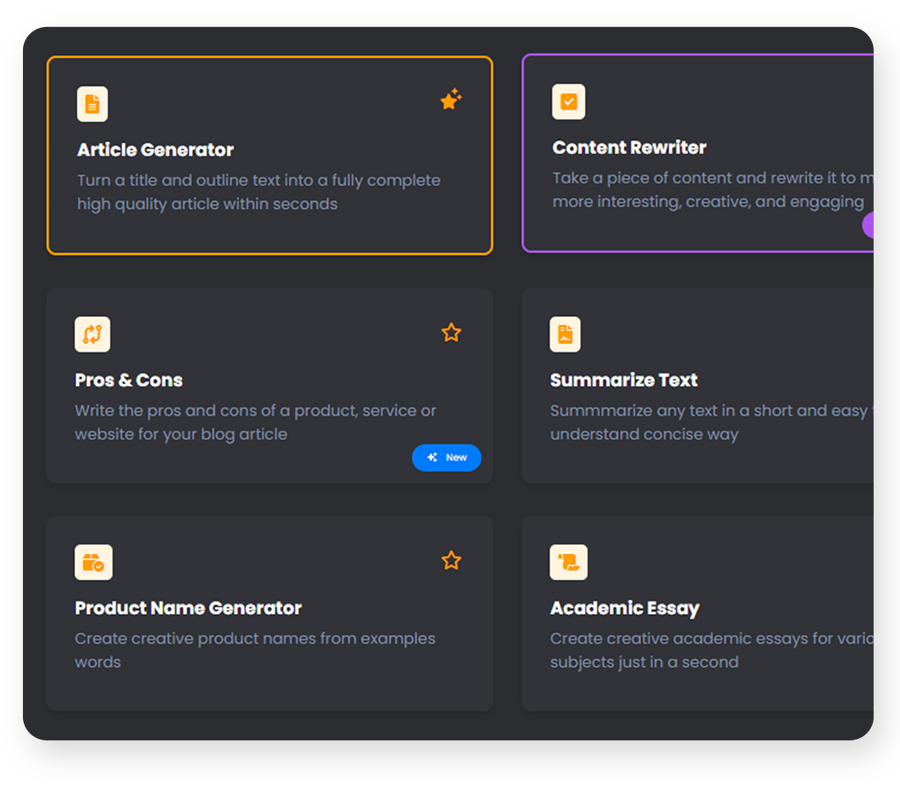
Article Generator
Turn a title and outline text into a fully complete high quality article within seconds
Content Rewriter
Take a piece of content and rewrite it to make it more interesting, creative, and engaging
Paragraph Generator
Generate paragraphs about any topic including a keyword and in a specific tone of voice
Talking Points
Write short, simple and informative points for the subheadings of your article
Pros & Cons
Write the pros and cons of a product, service or website for your blog article
Summarize Text
Summarize any text in a short and easy to understand concise way
Product Description
Write the description about your product and why it worth it
Startup Name Generator
Generate cool, creative, and catchy names for your startup in seconds
Product Name Generator
Create creative product names from examples words
Academic Essay
Create creative academic essays for various subjects just in a second
Creative Stories
Allow AI to generate creative stories for you based on input text
Grammar Checker
Make sure that there are no errors in your content
Summarize for 2nd Grader
Summarize any complex content for a 2nd grader child
Text Extender
Extend your sentences with more description and additional information
Rewrite with Keywords
Rewrite your existing content with including specific keywords
Business Ideas
Generate business ideas based on your keywords and description
Tone Changer
Change the tone of your writing to match your audience
Dictionary
Use a dictionary to find all details of your word
Privacy Policy
Develop a privacy policy information for your organization
Terms and Conditions
Develop a terms and conditions information for your organization
Ecommerce
Powerful tools for e-commerce, listings of your products
Great AI tool to use for academic essay writing and summarising texts!
Josh P
UK
5
Absolutely blown away with the quality of the writing that the AI provides and all the different features, one of the best i've used by far.
Laura S
UK
5
Using this for university and its made my life so much easier!
Tom W
UK
5
Really impressed with everything thats offered by the price!
Sarah
UK
5
Used this when I had a writers block and wow! one of the best features is being able to change the writing tone and style of each text.
Peter Scott
UK
5
An absolute dream for an assignment that I had due. I was skeptical at first, but after seeing my grades go up I use wordfairy for all of my coursework.
John Cross
UK
5
Woohoo! Word Fairy AI just sprinkled some serious writing magic in my life! It's like having a personal writing assistant that never sleeps.
Tim
UK
5
I'm not exaggerating when I say Word Fairy AI is the Dumbledore of writing tools. It's like having a magical professor guiding me through the writing process. I was skeptical at first—it's AI after all, right? But boy, was I proven wrong!
Kira Brown
UK
5
Finally met my writing soulmate! Word Fairy AI has become my brainstorm buddy, my grammar guru, and my secret weapon in the writing world. Its artificial intelligence beams with brilliance, offering word choices I'd never even think of!
Rob
UK
5
Writing just got a major upgrade, thanks to Word Fairy AI! It's like having a pocket-sized Shakespeare with impeccable grammar skills! This clever tool turns my writing foes into friends, fixing those sneaky typos and suggesting ways to improve clarity.
Bill
UK
5
Word Fairy AI is a total game-changer! It's like having a writing superhero by my side, guiding me through every paragraph. It spins my ideas into engaging content effortlessly.
Carol K
UK
5
Wow, Word Fairy AI has turned me into a wordsmith extraordinaire! I used to struggle with writer's block, but with this incredible writing tool, ideas flow like a river.
Rafique
UK
5
Prepare to be mind-blown by Word Fairy AI! This brilliant tool is my secret weapon in the battle against dull content. It sprinkles captivating phrases and catchy headlines all over my writing. Breath-taking AI-powered magic at its best.
Bella
UK
5
Wowza! Word Fairy AI is the writing genie I never knew I needed! With just a few clicks, it conjures up impeccable sentences and helps structure my thoughts flawlessly. Writing, editing, and proofreading have become a breeze.
Antonio
UK
5
This brilliant tool sprinkles dazzling vocabulary and grammar skills into your work, making it shine like a supernova. No more worrying about errors or boring content.
Jenny
UK
5
This baby corrects my clumsy wording, suggests better sentence structures, and even helps me find the perfect synonyms to spice things up. Seriously, if you've ever struggled with writing, let the Word Fairy AI work its magic for you!"
Iris
UK
5
t's like having a personal coach, pushing me towards better writing. Whether I'm composing a professional email or a creative masterpiece, this tool sprinkles linguistic fairy dust on every word. If you're tired of mediocre writing, make Word Fairy AI your new BFF!
Chen
UK
5
My productivity and creativity have hit the stratosphere thanks to this incredible AI. Prepare yourself for word wizardry!
Sumaya
UK
5
Seriously, where has this little AI genius been all my life? Writing projects have become a breeze, and my work is so much more polished now. Word Fairy AI, you've earned your wings in my heart!
Ellie
UK
5
Thanks to this genius AI, my writing has soared to new heights! I can't wait to see what magical stories we'll create together next!
Adam G
USA
5
Great AI tool to use for academic essay writing and summarising texts!
Josh P
UK
5
Absolutely blown away with the quality of the writing that the AI provides and all the different features, one of the best i've used by far.
Laura S
UK
5
Using this for university and its made my life so much easier!
Tom W
UK
5
Really impressed with everything thats offered by the price!
Sarah
UK
5
Used this when I had a writers block and wow! one of the best features is being able to change the writing tone and style of each text.
Peter Scott
UK
5
An absolute dream for an assignment that I had due. I was skeptical at first, but after seeing my grades go up I use wordfairy for all of my coursework.
John Cross
UK
5
Woohoo! Word Fairy AI just sprinkled some serious writing magic in my life! It's like having a personal writing assistant that never sleeps.
Tim
UK
5
I'm not exaggerating when I say Word Fairy AI is the Dumbledore of writing tools. It's like having a magical professor guiding me through the writing process. I was skeptical at first—it's AI after all, right? But boy, was I proven wrong!
Kira Brown
UK
5
Finally met my writing soulmate! Word Fairy AI has become my brainstorm buddy, my grammar guru, and my secret weapon in the writing world. Its artificial intelligence beams with brilliance, offering word choices I'd never even think of!
Rob
UK
5
Writing just got a major upgrade, thanks to Word Fairy AI! It's like having a pocket-sized Shakespeare with impeccable grammar skills! This clever tool turns my writing foes into friends, fixing those sneaky typos and suggesting ways to improve clarity.
Bill
UK
5
Word Fairy AI is a total game-changer! It's like having a writing superhero by my side, guiding me through every paragraph. It spins my ideas into engaging content effortlessly.
Carol K
UK
5
Wow, Word Fairy AI has turned me into a wordsmith extraordinaire! I used to struggle with writer's block, but with this incredible writing tool, ideas flow like a river.
Rafique
UK
5
Prepare to be mind-blown by Word Fairy AI! This brilliant tool is my secret weapon in the battle against dull content. It sprinkles captivating phrases and catchy headlines all over my writing. Breath-taking AI-powered magic at its best.
Bella
UK
5
Wowza! Word Fairy AI is the writing genie I never knew I needed! With just a few clicks, it conjures up impeccable sentences and helps structure my thoughts flawlessly. Writing, editing, and proofreading have become a breeze.
Antonio
UK
5
This brilliant tool sprinkles dazzling vocabulary and grammar skills into your work, making it shine like a supernova. No more worrying about errors or boring content.
Jenny
UK
5
This baby corrects my clumsy wording, suggests better sentence structures, and even helps me find the perfect synonyms to spice things up. Seriously, if you've ever struggled with writing, let the Word Fairy AI work its magic for you!"
Iris
UK
5
t's like having a personal coach, pushing me towards better writing. Whether I'm composing a professional email or a creative masterpiece, this tool sprinkles linguistic fairy dust on every word. If you're tired of mediocre writing, make Word Fairy AI your new BFF!
Chen
UK
5
My productivity and creativity have hit the stratosphere thanks to this incredible AI. Prepare yourself for word wizardry!
Sumaya
UK
5
Seriously, where has this little AI genius been all my life? Writing projects have become a breeze, and my work is so much more polished now. Word Fairy AI, you've earned your wings in my heart!
Ellie
UK
5
Thanks to this genius AI, my writing has soared to new heights! I can't wait to see what magical stories we'll create together next!
Frequently Asked Questions
Got Questions? We have you covered
We are always here to provide full support and clear any doubts that you might have
What Is WordFairy AI?
Word Fairy AI is an advanced artificial intelligence writing tool designed to assist writers in creating high-quality and engaging content. Equipped with state-of-the-art algorithms, this innovative tool offers unparalleled writing guidance and support.
With Word Fairy AI, users can expect an intelligent and efficient writing partner that can generate ideas, provide grammar and spelling suggestions, and help structure essays, articles, or any written work. By leveraging the power of AI, this tool harnesses vast amounts of data and knowledge to deliver accurate and contextually relevant recommendations, saving writers valuable time and effort.
Gone are the days of struggling with writer's block or spending hours on end trying to perfect a sentence or paragraph. Word Fairy AI acts as a virtual mentor, offering creative inspiration and guiding users with well-crafted suggestions tailored to their specific writing needs. Whether you're an aspiring writer, a student, or a seasoned professional, this writing tool is your ultimate companion in the journey of crafting impeccable content.
Does Wordfairy AI Offer A Free Trial?
Absolutely! Word Fairy AI offers a free sign up and trail of 1000 words for you to see all of our different features and test out our custom AI software. We're certain that you will be blown away with how advanced and customised our software is.
What Is The Word Fairy AI Referral Scheme
Do you know anyone who can benefit from Word Fairy AI? Refer a friend and we will give you 50% of the value of the first month of their subscription in the form of a digital amazon voucher. Get in touch with us at admin@wordfairy.ai for more details!
How Does Word Fairy AI Work?
Equipped with cutting-edge algorithms, Word Fairy AI assists users in generating engaging and persuasive content across various genres and formats. From blog posts and marketing copy to academic papers and creative writing, this tool adapts to the specific writing style and requirements of each user, providing invaluable suggestions to enhance coherence, clarity, and overall impact.
What sets Word Fairy AI apart is its ability to learn and adapt to individual preferences and writing goals. As users interact with the tool, it gradually tailors its suggestions based on their writing patterns and preferences. This personalized approach ensures that each user receives the most relevant and helpful recommendations throughout their writing journey.
By leveraging the vast knowledge and deep understanding of language encoded within its algorithms, Word Fairy AI enables writers to express their ideas with precision and eloquence. From grammar and spelling corrections to insightful vocabulary suggestions, this tool acts as a virtual writing tutor, providing continuous feedback and support to help users reach their full potential.
How Are Texts Generated For The Same Answer Different?
What sets Word Fairy AI apart is its ability to analyze the context and purpose of the writing, generating tailored suggestions that resonate with the intended audience. By considering factors such as genre, tone, and target audience, this tool guides users toward crafting content that captivates and engages readers, making every written piece a masterpiece.
Furthermore, Word Fairy AI acts as a platform for continuous growth and improvement. By analyzing the writing patterns and preferences of each user, this tool learns and adapts, delivering increasingly accurate and contextually relevant suggestions as users interact with it more frequently. This personalized approach guarantees that each individual's unique style and voice shine through, fostering a sense of authenticity in every written work.
With its vast knowledge database and intricate understanding of language nuances, Word Fairy AI offers comprehensive writing support at users' fingertips. From instantaneous grammar checks to insightful vocabulary suggestions, this tool inspires users to push the boundaries of their writing abilities and enables them to create compelling and impactful content that resonates with their intended audience.
This means that even if the same question for the same topic is asked 100 times, there will be 100 unique and completely different answers with no similarities.
How Is Word Fairy AI Different From Chat GPT?
Word Fairy AI is distinct from Chat GPT in terms of its primary function and purpose. While Chat GPT is mainly designed to engage in conversational interactions and provide responses like a chatbot, Word Fairy AI focuses predominantly on enhancing the writing capabilities of its users. With a range of advanced language models and text generation algorithms, Word Fairy AI aims to assist individuals in crafting high-quality written content for various purposes, such as articles, reports, blog posts, or creative writing. By leveraging it's powerful AI technology, Word Fairy AI can provide users with intelligent suggestions, grammar corrections, and insightful recommendations to refine their writing skills and create compelling textual compositions.
Can I Use Word Fairy For My University Assignments?
Yes, you can definitely use Word Fairy for your university assignments. Word Fairy AI is an advanced artificial intelligence writing tool designed to assist users in creating well-written and professional documents. Its powerful features, such as grammar and spell-check, suggest improvements, and content enhancement, make it an ideal tool for academic writing.
Word Fairy AI ensures that your assignments are free from grammatical errors, typos, and awkward phrasing. This tool not only helps you proofread your work but also offers suggestions for improving sentence structure, vocabulary usage, and overall coherence. It acts as a virtual writing assistant, providing valuable feedback to enhance the quality of your assignments.
Moreover, Word Fairy AI saves you time and effort by automating tedious tasks such as citations and bibliography formatting. With its comprehensive database of citation styles, including APA, MLA, and Chicago, you can be confident that your references are accurately formatted. This allows you to focus more on the content of your assignments, ensuring it meets the high academic standards set by your university.
It is important to note that while Word Fairy AI assists and streamlines the writing process, it is still your responsibility as a student to ensure the integrity of your work. The tool's primary purpose is to enhance your writing skills and provide suggestions, but ultimately, you must ensure that the content and ideas presented in your assignments are original and properly cited.
In summary, Word Fairy AI is an invaluable tool for your university assignments. It provides a range of features designed to improve your writing, enhance the quality of your work, and save you time. By using Word Fairy AI, you can confidently submit well-written and professional assignments that meet the academic standards of your university.
I Still Have Questions
No Problem at all! Please feel free to get in touch with us at admin@wordfairy.ai and we would be more than happy to help























Facebook Ads
Write Facebook ads that engage your audience and deliver a high conversion rate
Instagram Captions
Grab attention with catchy captions for your Instagram posts
Instagram Hashtags Generator
Find the best hashtags to use for your Instagram posts
Social Media Post (Personal)
Write a social media post for yourself to be published on any platform
Social Media Post (Business)
Write a post for your business to be published on any social media platform
Facebook Headlines
Write catchy and convincing headlines to make your Facebook Ads stand out
Google Ads Headlines
Write catchy 30-character headlines to promote your product with Google Ads
Google Ads Description
Write a Google Ads description that makes your ad stand out and generates leads
LinkedIn Posts
Create an interesting linkedin post with the help of AI
Twitter Tweets
Generate an interesting twitter tweets with AI
LinkedIn Ad Headlines
Attention-grabbing, click-inducing and high-converting ad headlines for LinkedIn
LinkedIn Ad Descriptions
Professional and eye-catching ad descriptions that will make your product shine