Critics have remarked that those four worthies were truly peerless throughout the ages; yet the present falls short of the past—the ancients favored unadorned simplicity, whereas the moderns prefer refined elegance. Styles of substance and ornament rise and fall in succession, shifting with the changing mores of the times; such evolution is simply the natural order of things. The ideal lies in honoring antiquity without clashing with the present, and embracing modernity without succumbing to its flaws—embodying that perfect balance of substance and refinement that defines the true gentleman. There is surely no need to abandon a carved palace in favor of a cave dwelling, or to trade a jade carriage for a primitive cart with solid wooden wheels.🌌 SpectraShell
#!/usr/bin/perl
#
# $Id: mytop,v 1.99-maria8 2025/07/16 17:59:26 jweisbuch Exp $
=pod
=head1 NAME
mytop - display MariaDB/MySQL server performance info like `top'
=cut
## most of the POD is at the bottom of the file
use 5.005;
use strict;
use warnings;
use DBI;
use Getopt::Long;
use Socket;
use List::Util qw(min max);
use File::Basename;
$main::VERSION = "1.99-maria8";
my $path_for_script = dirname($0);
$| = 1;
$0 = 'mytop';
my $WIN = ($^O eq 'MSWin32') ? 1 : 0;
## Test for color support.
eval { require Term::ANSIColor; };
my $HAS_COLOR = $@ ? 0 : 1;
$HAS_COLOR = 0 if $WIN;
## Test of Time::HiRes support
eval { require Time::HiRes };
my $HAS_TIME = $@ ? 0 : 1;
my $debug = 0;
## Try to lower our priority (which, who, pri)
setpriority(0,0,10) unless $WIN;
## Prototypes
sub Clear();
sub GetData();
sub GetQPS();
sub FullQueryInfo($);
sub Explain($);
sub PrintTable(@);
sub PrintHelp();
sub Sum(@);
sub commify($);
sub make_short($);
sub Hashes($);
sub Execute($);
sub StringOrRegex($);
sub GetInnoDBStatus();
sub GetCmdSummary();
sub GetShowVariables();
sub GetShowStatus();
sub cmd_s;
sub cmd_S;
sub cmd_q;
## Default Config Values
my %config = (
batchmode => 0,
color => 1,
db => '',
database => '',
delay => 5,
filter_user => qr/.?/,
filter_db => qr/.?/,
filter_host => qr/.?/,
filter_state => qr/.?/,
header => 1,
help => 0,
host => 'localhost',
idle => 1,
long => 120,
long_nums => 0,
mode => 'top',
prompt => 0,
pass => '',
password => '',
port => 3306,
resolve => 0,
slow => 10, ## slow query time
socket => '',
sort => 1, ## default or reverse sort ("s")
user => 'root',
fullqueries => 0, ## shows untruncated queries
usercol_width => 8, ## User column width
dbcol_width => 9, ## DB column width
hide_progress => 0 ## hide the "%" column when available
);
my %qcache = (); ## The query cache--used for full query info support.
my %ucache = (); ## The user cache--used for full killing by user
my %dbcache = (); ## The db cache. This should be merged at some point.
my %statcache = (); ## The show status cache for GetShowStatus()
my (%STATUS, %OLD_STATUS); # header stuff.
my $CLEAR = $WIN ? '': `clear`;
## Term::ReadKey values
my $RM_RESET = 0;
my $RM_NOBLKRD = 3; ## using 4 traps Ctrl-C :-(
## Add options from .my.cnf first
my $my_print_defaults;
if (!defined($my_print_defaults=my_which("my_print_defaults")))
{
print "Warning: Can't find my_print_defaults. Please add it to your PATH!\n";
exit(1);
}
unshift @ARGV, split "\n", `$my_print_defaults client mytop`;
## Read the user's config file, if it exists.
my $config = "$ENV{HOME}/.mytop";
if (-e $config)
{
if (open CFG, "<$config")
{
while (<CFG>)
{
next if /^\s*($|#)/; ## skip blanks and comments
chomp;
if (/(\S+)\s*=\s*(.*\S)/)
{
my ($k, $v) = ($1, $2);
if ($k =~ /^filter_/i) {
$config{lc $k} = StringOrRegex($v) if exists $config{lc $k};
} else {
$config{lc $k} = $v if exists $config{lc $k};
}
}
}
close CFG;
}
## map database/password onto db/pass
## short version gets precedence for historical reasons
$config{'db'} = $config{'database'} unless $config{'db'};
$config{'pass'} = $config{'password'} unless $config{'pass'};
}
## Command-line args.
use vars qw($opt_foo);
Getopt::Long::Configure('no_ignore_case', 'bundling');
GetOptions(
"color!" => \$config{color},
"user|u=s" => \$config{user},
"pass|password|p=s" => \$config{pass},
"database|db|d=s" => \$config{db},
"host|h=s" => \$config{host},
"port|P=i" => \$config{port},
"socket|S=s" => \$config{socket},
"delay|s=i" => \$config{delay},
"batch|batchmode|b" => \$config{batchmode},
"header!" => \$config{header},
"idle|i!" => \$config{idle},
"resolve|r!" => \$config{resolve},
"prompt!" => \$config{prompt},
"long=i" => \$config{long},
"long_nums!" => \$config{long_nums},
"mode|m=s" => \$config{mode},
"slow=i" => \$config{slow},
"sort=s" => \$config{sort},
"fullqueries|L!" => \$config{fullqueries},
"usercol_width=i" => \$config{usercol_width},
"dbcol_width=i" => \$config{dbcol_width},
"hide_progress|a!" => \$config{hide_progress}
);
## User may have put the port with the host.
if ($config{host} =~ s/:(\d+)$//)
{
$config{port} = $1;
}
## Don't use Term::ReadKey unless running interactively.
if (not $config{batchmode})
{
require Term::ReadKey;
Term::ReadKey->import();
}
## User may want to disable color.
if ($HAS_COLOR and not $config{color})
{
$HAS_COLOR = 0;
}
if ($HAS_COLOR)
{
import Term::ANSIColor ':constants';
}
else
{
*RESET = sub { };
*YELLOW = sub { };
*RED = sub { };
*MAGENTA = sub { };
*GREEN = sub { };
*BLUE = sub { };
*WHITE = sub { };
*BOLD = sub { };
}
my $RESET = RESET() || '';
my $YELLOW = YELLOW() || '';
my $RED = RED() || '';
my $MAGENTA = MAGENTA() || '';
my $GREEN = GREEN() || '';
my $BLUE = BLUE() || '';
my $WHITE = WHITE() || '';
my $BOLD = BOLD() || '';
## Connect
my $dsn;
## Socket takes precedence.
my $prefix= 'mysql';
if (eval {DBI->install_driver("MariaDB")}) {
$dsn = "DBI:MariaDB:database=$config{db};mariadb_read_default_group=mytop;";
$prefix= 'mariadb'
} else {
$dsn = "DBI:mysql:database=$config{db};mysql_read_default_group=mytop;";
}
if ($config{socket} and -S $config{socket})
{
$dsn .= "${prefix}_socket=$config{socket}";
}
elsif($config{host} eq "localhost")
{
$dsn .= "host=$config{host}";
}
else
{
$dsn .= "host=$config{host};port=$config{port}";
}
if ($config{prompt})
{
print "Password: ";
ReadMode(2);
chomp($config{pass} = <STDIN>);
ReadMode(0);
print "\n";
}
my $dbh = DBI->connect($dsn, $config{user}, $config{pass},
{ PrintError => 0 });
if (not ref $dbh)
{
my $Error = <<EODIE
Cannot connect to MariaDB/MySQL server. Please check the:
* database you specified "$config{db}" (default is "")
* username you specified "$config{user}" (default is "root")
* password you specified "$config{pass}" (default is "")
* hostname you specified "$config{host}" (default is "localhost")
* port you specified "$config{port}" (default is 3306)
* socket you specified "$config{socket}" (default is "")
The options my be specified on the command-line or in a ~/.mytop or
~/.my.cnf config file. See the manual (perldoc mytop) for details.
Here's the exact error from DBI. It might help you debug:
$DBI::errstr
EODIE
;
die $Error;
}
ReadMode($RM_RESET) unless $config{batchmode};
## Get static data
my $db_version;
my $db_release;
my $server = "MySQL";
my $have_query_cache;
my @variables = Hashes("SHOW VARIABLES");
foreach (@variables)
{
if ($_->{Variable_name} eq "version")
{
$db_version = $_->{Value};
$db_version =~ /^(\d+)/;
$db_release = $1;
$server = "MariaDB" if ($db_version =~ /maria/i);
# Get the version number only
$db_version = $1 if($db_version =~ m/(.*?)-/);
next;
}
if ($_->{Variable_name} eq "have_query_cache")
{
if ($_->{Value} ne 'NO')
{
$have_query_cache = 1;
}
else
{
$have_query_cache = 0;
}
next;
}
}
my ($has_is_processlist, $has_time_ms, $has_progress);
$has_is_processlist = $has_time_ms = $has_progress = 0;
## Check if the server has the INFORMATION_SCHEMA.PROCESSLIST table
## for backward compatibility
$has_is_processlist = Execute("SELECT /*mytop*/ 1 FROM INFORMATION_SCHEMA.TABLES
WHERE TABLE_SCHEMA = 'information_schema' AND
TABLE_NAME = 'PROCESSLIST';")->rows;
if ($has_is_processlist == 1)
{
## Check if the server has the TIME_MS column on the I_S.PROCESSLIST table
## If it is the case, it will fetch the query time with decimal precision
## for queries that has been running for less than 10k seconds
$has_time_ms = Execute("SELECT /*mytop*/ 1 FROM INFORMATION_SCHEMA.COLUMNS
WHERE TABLE_SCHEMA = 'information_schema' AND
TABLE_NAME = 'PROCESSLIST' AND
COLUMN_NAME = 'TIME_MS';")->rows;
if ($has_time_ms == 1)
{
## Check if the server has the STAGE column on the I_S.PROCESSLIST
## table (MariaDB) to retreive query completion information
$has_progress = Execute("SELECT /*mytop*/ 1 FROM INFORMATION_SCHEMA.COLUMNS
WHERE TABLE_SCHEMA = 'information_schema' AND
TABLE_NAME = 'PROCESSLIST' AND
COLUMN_NAME = 'STAGE';")->rows;
}
}
#########################################################################
##
## The main loop
##
#########################################################################
ReadMode($RM_NOBLKRD) unless $config{batchmode};
while (1)
{
my $key;
if ($config{mode} eq 'qps')
{
GetQPS();
$key = ReadKey(1);
next unless $key;
if ($key =~ /t/i)
{
$config{mode} = 'top';
}
if ($key =~ /q/)
{
cmd_q();
}
next;
}
if ($config{mode} eq 'top')
{
GetData();
last if $config{batchmode};
$key = ReadKey($config{delay});
next unless $key;
}
elsif ($config{mode} eq 'cmd')
{
GetCmdSummary();
last if $config{batchmode};
$key = ReadKey($config{delay});
next unless $key;
}
elsif ($config{mode} eq 'innodb')
{
GetInnoDBStatus();
last if $config{batchmode};
print "InnoDB Status [hit t to exit this mode or q to exit the application]\n";
$key = ReadKey($config{delay});
next unless $key;
}
elsif ($config{mode} eq 'status')
{
GetShowStatus();
last if $config{batchmode};
$key = ReadKey($config{delay});
next unless $key;
}
##
## keystroke command processing (if we get this far)
##
if ($key eq '!')
{
Execute("STOP /*mytop*/ SLAVE;");
Execute("SET /*mytop*/ GLOBAL sql_slave_skip_counter=1");
Execute("START /*mytop*/ SLAVE");
}
# t - top
if ($key =~ /t/i)
{
$config{mode} = 'top';
}
## q - quit
if ($key eq 'q')
{
cmd_q();
}
if ($key eq 'D')
{
require Data::Dumper;
print Data::Dumper::Dumper([\%config]);
ReadKey(0);
}
## l - change long running hightling
if ($key eq 'l')
{
cmd_l();
next;
}
## m - mode switch to qps
if ($key eq 'm')
{
$config{mode} = 'qps';
Clear() unless $config{batchmode};
print "Queries Per Second [hit t to exit this mode or q to exit the application]\n";
next;
}
## c - mode switch to command summary
if ($key eq 'c')
{
$config{mode} = 'cmd';
Clear() unless $config{batchmode};
print "Command Summary\n";
next;
}
## C - change Color on and off
if ($key eq 'C')
{
if ($HAS_COLOR)
{
$HAS_COLOR = 0;
}
else
{
$HAS_COLOR = 1;
}
}
## s - seconds of delay
if ($key eq 's')
{
cmd_s();
next;
}
if ($key eq 'S')
{
cmd_S();
next;
}
## R - resolve hostnames
if ($key eq 'R')
{
if ($config{resolve})
{
$config{resolve} = 0;
}
else
{
$config{resolve} = 1;
}
}
## t - username based filter
if ($key eq 't')
{
ReadMode($RM_RESET);
print RED(), "Which state (blank for all, /.../ for regex): ", RESET();
$config{filter_state} = StringOrRegex(ReadLine(0));
ReadMode($RM_NOBLKRD);
next;
}
## u - username based filter
if ($key eq 'u')
{
ReadMode($RM_RESET);
print RED(), "Which user (blank for all, /.../ for regex): ", RESET();
$config{filter_user} = StringOrRegex(ReadLine(0));
ReadMode($RM_NOBLKRD);
next;
}
## d - database name based filter
if ($key eq 'd')
{
ReadMode($RM_RESET);
print RED(), "Which database (blank for all, /.../ for regex): ",
RESET();
$config{filter_db} = StringOrRegex(ReadLine(0));
ReadMode($RM_NOBLKRD);
next;
}
## h - hostname based filter
if ($key eq 'h')
{
ReadMode($RM_RESET);
print RED(), "Which hostname (blank for all, /.../ for regex): ",
RESET();
$config{filter_host} = StringOrRegex(ReadLine(0));
ReadMode($RM_NOBLKRD);
next;
}
## E - Show full Replication Error
if ($key eq 'E')
{
my ($data) = Hashes('SHOW /*mytop*/ SLAVE STATUS');
Clear();
print "Error is: $data->{Last_Error}\n";
print RED(), "-- paused. press any key to resume --", RESET();
ReadKey(0);
next;
}
## F - remove all filters
if ($key eq 'F')
{
$config{filter_host} = qr/.?/;
$config{filter_db} = qr/.?/;
$config{filter_user} = qr/.?/;
$config{filter_state} = qr/.?/;
print RED(), "-- display unfiltered --", RESET();
sleep 1;
next;
}
## p - pause
if ($key eq 'p')
{
print RED(), "-- paused. press any key to resume --", RESET();
ReadKey(0);
next;
}
## i - idle toggle
if ($key =~ /i/)
{
if ($config{idle})
{
$config{idle} = 0;
$config{sort} = 1;
print RED(), "-- idle (sleeping) processed filtered --", RESET();
sleep 1;
}
else
{
$config{idle} = 1;
$config{sort} = 0;
print RED(), "-- idle (sleeping) processed unfiltered --", RESET();
sleep 1;
}
}
## I - InnoDB status
if ($key =~ 'I')
{
$config{mode} = 'innodb';
Clear() unless $config{batchmode};
print "InnoDB Status\n";
next;
}
## o - sort order
if ($key =~ /o/)
{
if ($config{sort})
{
$config{sort} = 0;
print RED(), "-- sort order reversed --", RESET();
sleep 1;
}
else
{
$config{sort} = 1;
print RED(), "-- sort order reversed --", RESET();
sleep 1;
}
}
## ? - help
if ($key eq '?')
{
Clear();
PrintHelp();
ReadKey(0);
next;
}
## k - kill
if ($key eq 'k')
{
ReadMode($RM_RESET);
print RED(), "Thread id to kill: ", RESET();
my $id = ReadLine(0);
$id =~ s/\s//g;
if ($id =~ /^\d+$/)
{
Execute("KILL /*mytop*/ $id");
}
else
{
print RED(), "-- invalid thread id --", RESET();
sleep 1;
}
ReadMode($RM_NOBLKRD);
next;
}
## K - kill based on a username
if ($key =~ /K/)
{
ReadMode($RM_RESET);
print RED(), "User to kill: ", RESET();
my $user = ReadLine(0);
$user =~ s/\s//g;
if ($user =~ /^\S+$/)
{
for my $pid (keys %ucache)
{
next unless $ucache{$pid} eq $user;
Execute("KILL /*mytop*/ $pid");
select(undef, undef, undef, 0.2);
}
}
else
{
print RED(), "-- invalid thread id --", RESET();
sleep 1;
}
ReadMode($RM_NOBLKRD);
}
## f - full info
if ($key =~ /f/)
{
ReadMode($RM_RESET);
print RED(), "Full query for which thread id: ", RESET();
my $id = ReadLine(0);
chomp $id;
FullQueryInfo($id);
ReadMode($RM_NOBLKRD);
print RED(), "-- paused. press any key to resume or (e) to explain --",
RESET();
my $key = ReadKey(0);
if ($key eq 'e')
{
Explain($id);
print RED(), "-- paused. press any key to resume --", RESET();
ReadKey(0);
}
next;
}
## e - explain
if ($key =~ /e/)
{
ReadMode($RM_RESET);
print RED(), "Explain which query (id): ", RESET();
my $id = ReadLine(0);
chomp $id;
Explain($id);
ReadMode($RM_NOBLKRD);
print RED(), "-- paused. press any key to resume --", RESET();
ReadKey(0);
next;
}
## r - reset status counters
if ($key =~ /r/)
{
Execute("FLUSH /*mytop*/ STATUS");
print RED(), "-- counters reset --", RESET();
sleep 1;
next;
}
## H - header toggle
if ($key eq 'H')
{
if ($config{header})
{
$config{header} = 0;
}
else
{
$config{header}++;
}
}
## # - magic debug key
if ($key eq '#')
{
$debug = 1;
}
if ($key eq 'V')
{
GetShowVariables();
print RED(), "-- paused. press any key to resume --", RESET();
ReadKey(0);
}
## M - switch to SHOW STATUS mode
if ($key eq 'M')
{
$config{mode} = 'status';
}
## L - full queries toggle
if ($key eq 'L')
{
if ($config{fullqueries})
{
$config{fullqueries} = 0;
print RED(), "-- full queries OFF --", RESET();
sleep 1;
}
else
{
$config{fullqueries} = 1;
print RED(), "-- full queries ON --", RESET();
sleep 1;
}
}
## w - change columns width for the "User" and "Database" columns
if ($key eq 'w')
{
ReadMode($RM_RESET);
print RED(), "Width for the 'User' column (the actual value is ".
$config{usercol_width}."): ";
my $readWidth = ReadLine(0);
chomp($readWidth);
if (defined($readWidth) && $readWidth ne "")
{
if ($readWidth > 4 && $readWidth < 60)
{
$config{usercol_width} = $readWidth;
}
else
{
print RED(), "-- Invalid value ($readWidth), the previous value".
"has been kept, press a key to resume --";
ReadKey(0);
}
}
print RESET(), RED(), "Width for the 'DB' column (the actual value is ".
$config{dbcol_width}."): ", RESET();
$readWidth = ReadLine(0);
chomp($readWidth);
if (defined($readWidth) && $readWidth ne "")
{
if ($readWidth > 2 && $readWidth < 60)
{
$config{dbcol_width} = $readWidth
}
else
{
print RED(), "-- Invalid value ($readWidth), the previous value".
"has been kept, press a key to resume --", RESET();
ReadKey(0);
}
}
undef $readWidth;
ReadMode($RM_NOBLKRD);
next;
}
## a - progress column toggle (the column is only displayed
## if progress information are available from the processlist)
if ($key eq 'a')
{
if ($config{hide_progress})
{
$config{hide_progress} = 0;
print RED(), "-- progress display ON --", RESET();
sleep 1;
}
else
{
$config{hide_progress} = 1;
print RED(), "-- progress display OFF --", RESET();
sleep 1;
}
}
}
ReadMode($RM_RESET) unless $config{batchmode};
exit;
#######################################################################
sub Clear()
{
if (not $WIN)
{
print "$CLEAR"
}
else
{
print "\n" x 90; ## dumb hack for now. Anyone know how to
## clear the screen in dos window on a Win32
## system??
}
}
my $last_time;
sub GetData()
{
## Get terminal info
my $now_time;
%qcache = (); ## recycle memory
%dbcache = ();
my ($width, $height, $wpx, $hpx, $lines_left);
if (not $config{batchmode})
{
($width, $height, $wpx, $hpx) = GetTerminalSize();
$lines_left = $height - 2;
}
else
{
$height = 999_999; ## I hope you don't have more than that!
$lines_left = 999_999;
$width = 80;
}
##
## Header stuff.
##
if ($config{header})
{
my @recs = "";
if ($db_release > 4)
{
@recs = Hashes("SHOW /*mytop*/ GLOBAL STATUS");
}
else
{
@recs = Hashes("SHOW /*mytop*/ STATUS");
}
## if the server died or we lost connectivity
if (not @recs)
{
ReadMode($RM_RESET);
exit 1;
}
## get high-res or low-res time
my ($t_delta);
if ($HAS_TIME)
{
$now_time = Time::HiRes::gettimeofday();
}
else
{
$now_time = time;
}
if ($last_time and $last_time != $now_time)
{
$t_delta = $now_time - $last_time;
}
%OLD_STATUS = %STATUS;
# Set some status that may not exist in all versions
$STATUS{Handler_tmp_write} = 0;
$STATUS{Handler_tmp_update} = 0;
$STATUS{Rows_tmp_read} = 0;
foreach my $ref (@recs)
{
my $key = $ref->{Variable_name};
my $val = $ref->{Value};
$STATUS{$key} = $val;
}
## Compute Key Cache Hit Stats
$STATUS{Key_read_requests} ||= 1; ## can't divide by zero next
my $cache_hits_percent = (100-($STATUS{Key_reads}/$STATUS{Key_read_requests}) * 100);
$cache_hits_percent = sprintf("%2.2f",$cache_hits_percent);
## Query Cache info for <= Ver. 4.1
##
## mysql> show status like 'qcache%';
## +-------------------------+----------+
## | Variable_name | Value |
## +-------------------------+----------+
## | Qcache_queries_in_cache | 81 |
## | Qcache_inserts | 4961668 |
## | Qcache_hits | 1374170 |
## | Qcache_not_cached | 5656249 |
## | Qcache_free_memory | 33164800 |
## | Qcache_free_blocks | 2 |
## | Qcache_total_blocks | 168 |
## +-------------------------+----------+
##
## Query Cache info for => Ver. 5.0
##
## mysql> show status like 'qcache%';
## +-------------------------+------------+
## | Variable_name | Value |
## +-------------------------+------------+
## | Qcache_free_blocks | 37652 |
## | Qcache_free_memory | 110289712 |
## | Qcache_hits | 1460617356 |
## | Qcache_inserts | 390563495 |
## | Qcache_lowmem_prunes | 6414172 |
## | Qcache_not_cached | 93002420 |
## | Qcache_queries_in_cache | 66558 |
## | Qcache_total_blocks | 192031 |
## +-------------------------+------------+
my $query_cache_hits = 0;
my $query_cache_hits_per_sec = 0;
my $now_query_cache_hits_per_sec = 0;
if ($have_query_cache)
{
$query_cache_hits = $STATUS{Qcache_hits};
$query_cache_hits_per_sec = $STATUS{Qcache_hits} / $STATUS{Uptime};
if (defined $last_time and $last_time != $now_time)
{
my $q_delta = $STATUS{Qcache_hits} - $OLD_STATUS{Qcache_hits};
$now_query_cache_hits_per_sec = sprintf "%.2f", $q_delta / $t_delta;
}
}
my $l;
if (-e "/proc/loadavg")
{
## To avoid warnings if the OS is not Linux
open (my $fh, "<", "/proc/loadavg");
## Only the first 3 values are interresting
$l = join(" ", (split /\s+/, <$fh>)[0..2]);
close $fh;
}
$last_time = $now_time;
## Server Uptime in meaningful terms...
my $time = $STATUS{Uptime};
my ($d,$h,$m,$s) = (0, 0, 0, 0);
$d += int($time / (60*60*24)); $time -= $d * (60*60*24);
$h += int($time / (60*60)); $time -= $h * (60*60);
$m += int($time / (60)); $time -= $m * (60);
$s += int($time);
my $uptime = sprintf("%d+%02d:%02d:%02d", $d, $h, $m, $s);
## Queries per second...
my $avg_queries_per_sec = sprintf("%.2f", $STATUS{Questions} / $STATUS{Uptime});
my $num_queries = $STATUS{Questions};
my @t = localtime(time);
my $current_time = sprintf "[%02d:%02d:%02d]", $t[2], $t[1], $t[0];
my $host_width = length("$server $db_version on $config{host}");
my $up_width = $width - $host_width - 1;
Clear() unless $config{batchmode};
print RESET();
printf "%-.${host_width}s %${up_width}s\n",
"$server $db_version on $config{host}",
defined($l) ? "load ($l) up $uptime $current_time" : "up $uptime $current_time";
$lines_left--;
printf " Queries: %-7s qps: %4.0f Slow: %7s Se/In/Up/De(%%): %02.0f/%02.0f/%02.0f/%02.0f\n",
make_short( $STATUS{Questions} ), # q total
$STATUS{Questions} / $STATUS{Uptime}, # qps, average
make_short( $STATUS{Slow_queries} ), # slow
# hmm. a Qcache hit is really a select and should be counted.
100 * ($STATUS{Com_select} + ($STATUS{Qcache_hits}||0) ) / $STATUS{Questions},
100 * ($STATUS{Com_insert} + $STATUS{Com_replace} ) / $STATUS{Questions},
100 * ($STATUS{Com_update} ) / $STATUS{Questions},
100 * $STATUS{Com_delete} / $STATUS{Questions};
$lines_left--;
if ($t_delta)
{
my $q_diff = ( $STATUS{Questions} - $OLD_STATUS{Questions} );
# print("q_diff: $STATUS{Questions} - $OLD_STATUS{Questions} / $t_delta = $q_diff\n");
printf(" Sorts: %6.0f qps now: %4.0f Slow qps: %3.1f Threads: %4.0f (%4.0f/%4.0f) %02.0f/%02.0f/%02.0f/%02.0f\n",
( $STATUS{Sort_rows} - $OLD_STATUS{Sort_rows} ) / $t_delta,
( $STATUS{Questions} - $OLD_STATUS{Questions} ) / $t_delta,
( # slow now (qps)
($STATUS{Slow_queries} ) ?
( $STATUS{Slow_queries} - $OLD_STATUS{Slow_queries} ) / $t_delta :
0
),
$STATUS{Threads_connected},
$STATUS{Threads_running},
$STATUS{Threads_cached},
(100 * ($STATUS{Com_select} - $OLD_STATUS{Com_select} +
($STATUS{Qcache_hits}||0) - ($OLD_STATUS{Qcache_hits}||0)
) ) / ($q_diff ),
(100 * ($STATUS{Com_insert} - $OLD_STATUS{Com_insert} +
$STATUS{Com_replace} - $OLD_STATUS{Com_replace}
) ) / ($q_diff ),
(100 * ($STATUS{Com_update} - $OLD_STATUS{Com_update}) ) / ($q_diff ),
(100 * ($STATUS{Com_delete} - $OLD_STATUS{Com_delete}) ) / ($q_diff ),
);
}
else
{
print "\n";
}
$lines_left--;
if ($have_query_cache and $STATUS{Com_select} and $query_cache_hits)
{
printf(" Cache Hits: %-5s Hits/s: %4.1f Hits now: %5.1f Ratio: ",
make_short($STATUS{Qcache_hits}), # cache hits
$STATUS{Qcache_hits} / $STATUS{Uptime}, # hits / sec
($t_delta) ? ($STATUS{Qcache_hits} - $OLD_STATUS{Qcache_hits}) / $t_delta : 0, # Hits Now
);
my ($Ratio) = 100 * ($STATUS{Qcache_hits}) / ($STATUS{Qcache_hits} + $STATUS{Com_select} );
if ($HAS_COLOR)
{
print YELLOW() if ($Ratio < 80.0);
print RED() if ($Ratio < 50.0);
print MAGENTA() if ($Ratio < 20.0);
}
printf("%4.1f%% ",$Ratio);
if ($HAS_COLOR)
{
print RESET();
}
print " Ratio now: ";
my ($Ratio_now) = ($t_delta) ? # ratio now
100 * ($STATUS{Qcache_hits} - $OLD_STATUS{Qcache_hits} ) /
( ($STATUS{Com_select} + $STATUS{Qcache_hits} -
($OLD_STATUS{Qcache_hits} + $OLD_STATUS{Com_select})
) || 1) : 0;
if ($HAS_COLOR)
{
print GREEN() if ($Ratio_now >= 80.0);
print YELLOW() if ($Ratio_now < 80.0);
print RED() if ($Ratio_now < 50.0);
print MAGENTA() if ($Ratio_now < 20.0);
}
printf("%4.1f%% \n",$Ratio_now);
if ($HAS_COLOR)
{
print RESET();
}
$lines_left--;
}
if ($t_delta)
{
my $rows_read;
if (defined($STATUS{Rows_read}))
{
$rows_read= $STATUS{Rows_read} - $OLD_STATUS{Rows_read};
}
else
{
$rows_read=
($STATUS{Handler_read_first} + $STATUS{Handler_read_key} +
$STATUS{Handler_read_next} + $STATUS{Handler_read_prev} +
$STATUS{Handler_read_rnd} + $STATUS{Handler_read_rnd_next} -
$OLD_STATUS{Handler_read_first} - $OLD_STATUS{Handler_read_key} -
$OLD_STATUS{Handler_read_next} - $OLD_STATUS{Handler_read_prev} -
$OLD_STATUS{Handler_read_rnd} - $OLD_STATUS{Handler_read_rnd_next});
}
printf(" Handler: (R/W/U/D) %5d/%5d/%5d/%5d Tmp: R/W/U: %5d/%5d/%5d\n",
$rows_read/$t_delta,
($STATUS{Handler_write} - $OLD_STATUS{Handler_write}) /
$t_delta,
($STATUS{Handler_update} - $OLD_STATUS{Handler_update}) /
$t_delta,
($STATUS{Handler_delete} - $OLD_STATUS{Handler_delete}) /
$t_delta,
($STATUS{Rows_tmp_read} - $OLD_STATUS{Rows_tmp_read}) /
$t_delta,
($STATUS{Handler_tmp_write}
-$OLD_STATUS{Handler_tmp_write})/$t_delta,
($STATUS{Handler_tmp_update} -
$OLD_STATUS{Handler_tmp_update})/$t_delta);
}
else
{
print "\n";
}
$lines_left--;
printf(" MyISAM Key Cache Efficiency: %2.1f%% Bps in/out: %5s/%5s ",
$cache_hits_percent,
make_short($STATUS{Bytes_received} / $STATUS{Uptime} ),
make_short($STATUS{Bytes_sent} / $STATUS{Uptime}));
printf("Now in/out: %5s/%5s",
make_short(($STATUS{Bytes_received} - $OLD_STATUS{Bytes_received}) / $t_delta ),
make_short(($STATUS{Bytes_sent} - $OLD_STATUS{Bytes_sent}) / $t_delta ))
if ($t_delta);
print "\n";
$lines_left--;
my ($data) = Hashes('SHOW /*mytop*/ GLOBAL VARIABLES LIKE "read_only"');
if ($data->{Value} ne "OFF")
{
print RED() if ($HAS_COLOR) ;
print " ReadOnly";
RESET() if ($HAS_COLOR);
}
($data) = Hashes('SHOW /*mytop*/ SLAVE STATUS');
if (defined($data->{Master_Host}))
{
if (defined($data->{Seconds_Behind_Master}))
{
if ($HAS_COLOR)
{
print GREEN();
print YELLOW() if ($data->{Seconds_Behind_Master} > 60);
print MAGENTA() if ($data->{Seconds_Behind_Master} > 360);
}
}
print " Replication ";
print "IO:$data->{Slave_IO_Running} ";
print "SQL:$data->{Slave_SQL_Running} ";
print RESET() if ($HAS_COLOR);
if (defined($data->{Seconds_Behind_Master}))
{
if ($HAS_COLOR)
{
print GREEN();
print YELLOW() if ($data->{Seconds_Behind_Master} > 60);
print MAGENTA() if ($data->{Seconds_Behind_Master} > 360);
}
print "Delay: $data->{Seconds_Behind_Master} sec.";
}
else
{
my $free = $width - 45;
my $Err = substr $data->{Last_Error},0 ,$free;
printf(" ERR: %-${free}s", $Err) if ($Err ne "");
}
print WHITE() if ($HAS_COLOR);
print "\n";
$lines_left--;
}
print "\n";
}
if (not $config{batchmode} and not $config{header})
{
Clear();
print RESET();
}
##
## Threads
##
my $proc_cmd; ## Query used to fetch the processlist
my $time_format = "6d";
if ($has_is_processlist == 1)
{
if ($has_time_ms == 1)
{
$time_format = "6.6s";
if ($has_progress == 1)
{
## To have a computed value of "Progress" like the
## "SHOW PROCESSLIST" one, the Progress column of the query
## must be replaced by :
## "CASE WHEN Max_Stage < 2 THEN Progress ELSE
## (Stage-1)/Max_Stage*100+Progress/Max_Stage END AS Progress"
$proc_cmd = "SELECT /*mytop*/ Id, User, Host, db, Command,
CASE WHEN TIME > 10000 THEN Time ELSE
ROUND(TIME_MS/1000, 1) END AS Time,
State, Info, Progress, Stage, Max_Stage
FROM INFORMATION_SCHEMA.PROCESSLIST
WHERE ID != CONNECTION_ID();";
}
else
{
$proc_cmd = "SELECT /*mytop*/ Id, User, Host, db, Command,
CASE WHEN TIME > 10000 THEN Time ELSE
ROUND(TIME_MS/1000, 1) END AS Time,
State, Info FROM INFORMATION_SCHEMA.PROCESSLIST
WHERE ID != CONNECTION_ID();";
}
}
else
{
$proc_cmd = "SELECT /*mytop*/ Id, User, Host, db, Command, Time,
State, Info FROM INFORMATION_SCHEMA.PROCESSLIST
WHERE ID != CONNECTION_ID();";
}
}
else
{
$proc_cmd = "SHOW /*mytop*/ FULL PROCESSLIST;";
}
## Minimal width values for columns with a dynamic width
if ($config{usercol_width} < 4) { $config{usercol_width} = 4; }
if ($config{dbcol_width} < 2) { $config{dbcol_width} = 2; }
my @sz = (9, $config{usercol_width}, 15, $config{dbcol_width}, 6, 6, 8);
if ($has_progress == 1 && !$config{hide_progress}) { push @sz, 5; };
my $used = scalar(@sz) + Sum(@sz);
undef(@sz);
## If the terminal width <= 80, the state column will have a width of 6
## chars else it will be between 6 and 15 depending on the terminal width
my $state = $width <= 80 ? 6 : int(min(6+($width-80)/3, 15));
## $free = The number of chars between the beginning of the "Query"
## column and the end of the line
my $free = $width - $used - ($state - 6);
my $format= "%9s %$config{usercol_width}s %15s %$config{dbcol_width}s %6s ";
if ($has_progress == 1 && !$config{hide_progress}) { $format .= "%5s "; }
$format .= "%6s %${state}s %-.${free}s\n";
my $format2 = "%9d %$config{usercol_width}.$config{usercol_width}s %15.15s %$config{dbcol_width}.$config{dbcol_width}s %${time_format} ";
if ($has_progress == 1 && !$config{hide_progress}) { $format2 .= "%5.1f "; }
$format2 .= "%6.6s %${state}.${state}s ";
if ($config{fullqueries})
{
$format2 .= "%-${free}s\n";
}
else
{
$format2 .= "%-${free}.${free}s\n";
}
print BOLD() if ($HAS_COLOR);
if ($has_progress == 1 && !$config{hide_progress})
{
printf $format,
'Id','User','Host/IP','DB','Time', '%', 'Cmd', 'State', 'Query';
}
else
{
printf $format,
'Id','User','Host/IP','DB','Time', 'Cmd', 'State', 'Query';
}
print RESET() if ($HAS_COLOR);
## Id User Host DB
if ($has_progress == 1 && !$config{hide_progress})
{
printf $format,
'--','----','-------','--','----', '-', '---', '-----', '----------';
}
else
{
printf $format,
'--','----','-------','--','----', '---', '-----', '----------';
}
$lines_left -= 2;
my @data = Hashes($proc_cmd);
foreach my $thread (@data)
{
last if not $lines_left;
## Drop Domain Name, unless it looks like an IP address. If
## it's an IP, we'll strip the port number because it's rarely
## interesting.
my $is_ip = 0;
if ($thread->{Host} =~ /^(\d{1,3}\.){3}(\d{1,3})(:\d+)?$/)
{
$thread->{Host} =~ s/:.*$//;
$is_ip = 1;
}
else
{
$thread->{Host} =~ s/^([^.]+).*/$1/;
}
## Otherwise, look up the IP (if resolve is set) and strip the
## name
if ($is_ip and $config{resolve})
{
$thread->{Host} =~ s/:\d+$//;
my $host = gethostbyaddr(inet_aton($thread->{Host}), AF_INET);
if ($host)
{
## Only the hostname part of the DNS is kept
$host =~ s/^([^.]+).*/$1/;
}
$thread->{Host} = $host;
}
## Fix possible undefs
$thread->{db} ||= '';
$thread->{Info} ||= '';
$thread->{Time} ||= 0 ;
$thread->{Id} ||= 0 ;
$thread->{User} ||= '';
$thread->{Command} ||= '';
$thread->{Host} ||= '';
$thread->{State} ||= "";
$thread->{Progress} ||= 0;
## Alter double hyphen comments so they don't break
## the query when newlines are removed - http://freshmeat.net/users/jerjones
$thread->{Info} =~ s~\s--(.*)$~ /* $1 */ ~mg;
## Normalize spaces -- mostly disabled for now. This can
## break EXPLAIN if you try to explain a mangled query. It
## may be re-enabled later as an option.
## Replace newlines and carriage returns with a space
$thread->{Info} =~ tr/\n\r/ /;
## Leading space removal
$thread->{Info} =~ s/^\s*//;
## Strip non printing control symbols
$thread->{Info} =~ tr/[[:cntrl:]]//;
## Collpase whitespace
$thread->{Info} =~ s/\s+/ /g;
## Trailing space removal
$thread->{Info} =~ s/\s$//;
## Put the first letter of the query uppercase for a better readability
## with long State strings
$thread->{Info} = ucfirst $thread->{Info};
## Stow it in the cache
$qcache{$thread->{Id}} = $thread->{Info};
$dbcache{$thread->{Id}} = $thread->{db};
$ucache{$thread->{Id}} = $thread->{User};
## If Progress information is available and a multi-stage query is
## running, the actual stage and the total number of stages of the
## thread are shown at the beginning of the State column
if ($has_progress == 1 && $thread->{Max_Stage} && $thread->{Max_Stage} > 1)
{
$thread->{State} = $thread->{Stage}."/".
$thread->{Max_Stage}." ".$thread->{State};
}
}
## Sort by idle time (closest thing to CPU usage I can think of).
my @sorted;
if (not $config{sort})
{
@sorted = sort { $a->{Time} <=> $b->{Time} } @data
}
else
{
@sorted = sort { $b->{Time} <=> $a->{Time} } @data
}
foreach my $thread (@sorted)
{
## Check to see if we can skip out.
## We skip out if we know the given line doesn't match.
next if (($thread->{Command} eq "Sleep")
and
(not $config{idle}));
next if (($thread->{Command} eq "Binlog Dump")
and
(not $config{idle}));
next if (($thread->{Command} eq "Daemon")
and
(not $config{idle}));
next if ($thread->{User} !~ $config{filter_user});
next if ($thread->{db} !~ $config{filter_db});
next if ($thread->{Host} !~ $config{filter_host});
next if ($thread->{State} !~ $config{filter_state});
## Otherwise, print.
my $smInfo;
if ($thread->{Info})
{
if ($config{fullqueries})
{
$smInfo = $thread->{Info};
if (length($smInfo) > $free)
{
$lines_left -= int((length($smInfo) - $free)/$width) + 1;
}
}
else
{
$smInfo = substr $thread->{Info}, 0, $free;
}
}
# if ($thread->{State})
# {
# $smInfo = substr $thread->{State}, 0, $free;
# }
else
{
$smInfo = "";
}
$lines_left--;
if ($lines_left < 0)
{
print WHITE(), "-- Truncated query list -- ";
last;
}
if ($HAS_COLOR)
{
print YELLOW() if $thread->{Command} eq 'Query';
print WHITE() if $thread->{Command} eq 'Sleep';
print GREEN() if $thread->{Command} eq 'Connect';
print BOLD() if $thread->{Time} > $config{slow};
print MAGENTA() if $thread->{Time} > $config{long};
}
if ($has_progress == 1 && !$config{hide_progress})
{
printf $format2,
$thread->{Id}, $thread->{User}, $thread->{Host}, $thread->{db},
$thread->{Time}, $thread->{Progress}, $thread->{Command},
$thread->{State}, $smInfo;
}
else
{
printf $format2,
$thread->{Id}, $thread->{User}, $thread->{Host}, $thread->{db},
$thread->{Time}, $thread->{Command}, $thread->{State}, $smInfo;
}
print RESET() if $HAS_COLOR;
}
}
###########################################################################
my $questions;
sub GetQPS()
{
my ($data) = Hashes('SHOW /*mytop*/ STATUS LIKE "Questions"');
my $num = $data->{Value};
if (not defined $questions) ## first time?
{
$questions = $num;
return;
}
my $qps = $num - $questions;
$questions = $num;
print "$qps\n";
}
###########################################################################
sub GetInnoDBStatus()
{
if (not $config{pager})
{
if (not $config{pager} = my_which('less'))
{
$config{pager} = my_which('more');
}
}
my @data = Hashes("SHOW /*mytop*/ ENGINE INNODB STATUS");
open P, "|$config{pager}" or die "$!";
print keys %{$data[0]};
print $data[0]->{Status},"\n";
close P;
}
###########################################################################
my %prev_data;
sub GetCmdSummary()
{
my ($width, $height, $wpx, $hpx, $lines_left);
if (not $config{batchmode})
{
($width, $height, $wpx, $hpx) = GetTerminalSize();
$lines_left = $height - 2;
}
else
{
$height = 999_999; ## I hope you don't have more than that!
$lines_left = 999_999;
$width = 80;
}
## Variable_name and Value pairs come back...
my @data = Hashes("SHOW /*mytop*/ STATUS LIKE 'Com\\_%'");
my %cmd_data;
my %cmd_delta;
my %cmd_pct;
my %cmd_delta_pct;
my $total;
my $delta_total;
for my $item (@data)
{
next unless $item->{Value};
$item->{Variable_name} =~ s/^Com_//;
$item->{Variable_name} =~ s/_/ /g;
$cmd_data{$item->{Variable_name}} = $item->{Value};
$total += $item->{Value};
}
## Populate other stats
for my $item (keys %cmd_data)
{
$cmd_delta{$item} = $cmd_data{$item} -
($prev_data{$item} || $cmd_data{$item} - 1);
$delta_total += $cmd_delta{$item};
$cmd_pct{$item} = int(($cmd_data{$item} / $total) * 100);
}
for my $item (keys %cmd_data)
{
$cmd_delta_pct{$item} = int(($cmd_delta{$item} / $delta_total) * 100);
}
## Display
Clear() unless $config{batchmode};
print RESET();
printf "%18s %10s %4s | %5s %4s\n", 'Command', 'Total', 'Pct', 'Last', 'Pct';
printf "%18s %10s %4s | %5s %4s\n", '-------', '-----', '---', '----', '---';
$lines_left -= 2;
for my $item (sort { $cmd_data{$b} <=> $cmd_data{$a} } keys %cmd_data)
{
printf "%18s %10d %4s | %5d %4s\n",
$item,
$cmd_data{$item},
$cmd_pct{$item} . "%",
$cmd_delta{$item},
$cmd_delta_pct{$item} . "%";
last if not $lines_left;
$lines_left -= 1;
}
%prev_data = %cmd_data;
}
###########################################################################
sub GetShowVariables()
{
if (not $config{pager})
{
if (not $config{pager} = my_which('less'))
{
$config{pager} = my_which('more');
}
}
my @rows = Hashes("SHOW /*mytop*/ VARIABLES");
open P, "|$config{pager}" or die "$!";
for my $row (@rows)
{
my $name = $row->{Variable_name};
my $value = $row->{Value};
printf P "%32s: %s\n", $name, $value;
}
close P;
}
###########################################################################
sub GetShowStatus()
{
Clear() unless $config{batchmode};
my @rows = Hashes("SHOW /*mytop*/ STATUS");
printf "%32s %10s %10s Toggle idle with 'i'\n", 'Counter', 'Total', 'Change';
printf "%32s %10s %10s\n", '-------', '-----', '------';
for my $row (@rows)
{
my $name = $row->{Variable_name};
my $value = $row->{Value};
my $old = $statcache{$name};
my $delta = 0;
next if $name =~ m/^Com_/; ## skip Com_ stats
next if $value =~ m/^[^0-9]*$/; ## skip non-numeric
## TODO: if Qcache is off, we should skip Qcache_ values
if ($HAS_COLOR and defined $old and $old =~ /^\d/)
{
if ($value > $old)
{
print YELLOW();
$delta = $value - $old;
}
elsif ($value < $old)
{
print RED();
$delta = $value - $old;
}
if (not $config{idle} and $value == $old)
{
## filter unchanging stats, maybe
print RESET();
next;
}
}
printf "%32s: %10s %10s\n", $name, $value, $delta;
print RESET() if $HAS_COLOR;
$statcache{$name} = $value;
}
}
###########################################################################
sub FullQueryInfo($)
{
my $id = shift;
if (not exists $qcache{$id} or not defined $qcache{$id})
{
print "*** Invalid id. ***\n";
return;
}
my $sql = $qcache{$id};
print $CLEAR;
print "Thread $id was executing following query:\n\n";
print YELLOW(), $sql,"\n\n", RESET();
}
###########################################################################
sub Explain($)
{
my $id = shift;
if (not exists $qcache{$id} or not defined $qcache{$id})
{
print "*** Invalid id. ***\n";
return;
}
my $sql = $qcache{$id};
my $db = $dbcache{$id};
Execute("USE /*mytop*/ $db");
my @info = Hashes("EXPLAIN $sql");
print $CLEAR;
print "EXPLAIN $sql:\n\n";
PrintTable(@info);
}
###########################################################################
sub PrintTable(@)
{
my $cnt = 1;
my @cols = qw(table type possible_keys key key_len ref rows Extra);
for my $row (@_)
{
print "*** row $cnt ***\n";
for my $key (@cols)
{
my $val = $row->{$key} || 'NULL';
printf "%15s: %s\n", $key, $val;
}
$cnt++;
}
}
###########################################################################
sub StringOrRegex($)
{
my $input = shift;
chomp $input;
if (defined $input)
{
## regex, strip /.../ and use via qr//
if ($input =~ m{^/} and $input =~ m{/$})
{
$input =~ s{^/}{} if $config{filter_user};
$input =~ s{/$}{} if $config{filter_user};
$input = qr/$input/;
}
## reset to match anything
elsif ($input eq '')
{
$input = qr/.*/;
}
## string, build a simple regex
else
{
$input = '^' . $input . '$';
$input = qr/$input/;
}
}
## reset to match anything
else
{
$input = qr/.*/;
}
return $input;
}
###########################################################################
sub cmd_l
{
ReadMode($RM_RESET);
print RED(), "Seconds for long queries: ", RESET();
my $secs = ReadLine(0);
if ($secs =~ /^\s*(\d+)/)
{
$config{long} = $1;
if ($config{long} < 1)
{
$config{long} = 1;
}
}
ReadMode($RM_NOBLKRD);
}
sub cmd_s
{
ReadMode($RM_RESET);
print RED(), "Seconds of Delay: ", RESET();
my $secs = ReadLine(0);
if ($secs =~ /^\s*(\d+)/)
{
$config{delay} = $1;
if ($config{delay} < 1)
{
$config{delay} = 1;
}
}
ReadMode($RM_NOBLKRD);
}
sub cmd_S
{
ReadMode($RM_RESET);
print RED(), "Seconds for Slow queries: ", RESET();
my $secs = ReadLine(0);
if ($secs =~ /^\s*(\d+)/)
{
$config{slow} = $1;
if ($config{slow} < 1)
{
$config{slow} = 1;
}
}
ReadMode($RM_NOBLKRD);
}
sub cmd_q
{
ReadMode($RM_RESET);
print "\n";
exit;
}
sub trim($)
{
my $string = shift;
$string =~ s/^\s+//;
$string =~ s/\s+$//;
return $string;
}
###########################################################################
sub PrintHelp()
{
my $help = qq[Help for mytop version $main::VERSION by Jeremy D. Zawodny <${YELLOW}Jeremy\@Zawodny.com${RESET}>
with updates by Mark Grennan <${YELLOW}mark\@grennan.com${RESET}> and Jean Weisbuch <${YELLOW}jean\@phpnet.org${RESET}>
? - display this screen
# - debug mode (toggle)
c - command summary view (based on Com_* counters)
C - turn color on and off
d - show only a specific database
e - explain the query that a thread is running
E - display current replication error
f - show full query info for a given thread
F - unfilter the display
h - show only a specifc host's connections
H - toggle the mytop header
i - toggle the display of idle (sleeping) threads
I - show innodb status
k - kill a thread
p - pause the display
l - change long running queries hightlighing
m - switch [mode] to qps (queries/sec) scrolling view
M - switch [mode] to status
o - reverse the sort order (toggle)
q - quit
r - reset the status counters (via FLUSH STATUS on your server)
R - change reverse IP lookup
s - change the delay between screen updates
S - change slow query hightlighting
t - switch to thread view (default)
u - show only a specific user
V - show variables
: - enter a command (not yet implemented)
! - Skip an error that has stopped replications (at your own risk)
L - show full queries (do not strip to terminal width)
w - adjust the User and DB columns width
a - toggle the progress column
Base version from ${GREEN}http://www.mysqlfanboy.com/mytop-3${RESET}
This version comes as part of the ${GREEN}MariaDB${RESET} distribution.
];
print $help;
}
sub Sum(@)
{
my $sum;
while (my $val = shift @_) { $sum += $val; }
return $sum;
}
## A useful routine from perlfaq
sub commify($)
{
local $_ = shift;
return 0 unless defined $_;
1 while s/^([-+]?\d+)(\d{3})/$1,$2/;
return $_;
}
## Compact numeric representation (10,000 -> 10.0k)
sub make_short($)
{
my $number = shift;
return commify($number) if $config{long_nums};
my $n = 0;
while ($number > 1_025) { $number /= 1024; $n++; };
return sprintf "%.1f%s", $number, ('','k','M','G', 'T')[$n];
}
## Run a query and return the records has an array of hashes.
sub Hashes($)
{
my $sql = shift;
my @records;
if (my $sth = Execute($sql))
{
while (my $ref = $sth->fetchrow_hashref)
{
print "record\n" if $debug;
push @records, $ref;
}
}
return @records;
}
## Execute an SQL query and return the statement handle.
sub Execute($)
{
my $sql = shift;
$sql =~ s/\n/ /sg;
my $sth = $dbh->prepare($sql);
if (not $sth) { ReadMode($RM_RESET); die $DBI::errstr; }
my $ReturnCode = $sth->execute;
if (not $ReturnCode)
{
if ($debug)
{
print "query failed\n";
sleep 10;
}
return undef;
}
return $sth;
}
####
#### my_which is used, because we can't assume that every system has the
#### which command. my_which can take only one argument at a time.
#### Return values: requested system command with the first found path,
#### or undefined, if not found.
####
sub my_which
{
my ($command) = @_;
my (@paths, $path);
return $command if (-f $command && -x $command);
## Check first if this is a source distribution, then if this binary distribution and last in the path
push @paths, "./extra";
push @paths, $path_for_script;
push @paths, split(':', $ENV{'PATH'});
foreach $path (@paths)
{
$path .= "/$command";
return $path if (-f $path && -x $path);
}
return undef();
}
=pod
=head1 SYNOPSIS
B<mytop> [options]
=head1 AVAILABILITY
Base version from B<http://www.mysqlfanboy.com/mytop-3>.
This version comes as part of the B<MariaDB> distribution. See B<https://mariadb.org/>.
And older (the original) version B<mytop> is available from
http://www.mysqlfanboy.com/mytop-3/ it B<might> also be on CPAN as
well.
=head1 REQUIREMENTS
In order for B<mytop> to function properly, you must have the
following:
* Perl 5.005 or newer
* Getopt::Long
* DBI and DBD::MariaDB or DBD::mysql
* Term::ReadKey from CPAN
Most systems are likely to have all of those installed--except for
Term::ReadKey. You will need to pick that up from the CPAN. You can
pick up Term::ReadKey here:
http://search.cpan.org/search?dist=TermReadKey
And you obviously need access to a MariaDB server with the necessary
security to run the I<SHOW PROCESSLIST> and I<SHOW STATUS> commands.
If you are a Windows user, using ActiveState's Perl, you can use PPM
(the Perl Package Manager) to install the MariaDB/MySQL and Term::ReadKey
modules.
=head2 Optional Color Support
In additon, if you want a color B<mytop> (recommended), install
Term::ANSIColor from the CPAN:
http://search.cpan.org/search?dist=ANSIColor
Once you do, B<mytop> will automatically use it. However, color is not
yet working on Windows. Patches welcome. :-)
=head2 Optional Hi-Res Timing
If you want B<mytop> to provide more accurate real-time
queries-per-second statistics, install the Time::HiRes module from
CPAN. B<mytop> will automatically notice that you have it and use it
rather than the standard timing mechanism.
=head2 Platforms
B<mytop> is known to work on:
* Linux (2.2.x, 2.4.x)
* FreeBSD (2.2, 3.x, 4.x)
* Mac OS X
* BSDI 4.x
* Solaris 2.x
* Windows NT 4.x (ActivePerl)
If you find that it works on another platform, please let me
know. Given that it is all Perl code, I expect it to be rather
portable to Unix and Unix-like systems. Heck, it I<might> even work on
Win32 systems.
=head1 DESCRIPTION
Help is always welcome in improving this software. Feel free to
contact the author (see L<"AUTHOR"> below) with bug reports, fixes,
suggestions, and comments. Additionally L<"BUGS"> will provide a list
of things this software is not able to do yet.
Having said that, here are the details on how it works and what you can
do with it.
=head2 The Basics
B<mytop> was inspired by the system monitoring tool B<top>. I
routinely use B<top> on Linux, FreeBSD, and Solaris. You are likely to
notice features from each of them here.
B<mytop> will connect to a MariaDB server and periodically run the
I<SHOW PROCESSLIST> and I<SHOW STATUS> commands and attempt to
summarize the information from them in a useful format.
=head2 The Display
The B<mytop> display screen is really broken into two parts. The top 4
lines (header) contain summary information about your MariaDB
server. For example, you might see something like:
MariaDB 10.5.0 on localhost load (3.89 3.86 3.91) up 7+23:56:31 [16:33:01]
Queries: 353.4M qps: 531 Slow: 4.5k Se/In/Up/De(%): 87/02/02/00
Sorts: 2390 qps now: 651 Slow qps: 0.0 Threads: 11 ( 1/ 13) 88/01/03/00
Handler: (R/W/U/D) 82138/ 5884/ 20/ 1 Tmp: R/W/U: 13623/29501/ 79
MyISAM Key Cache Efficiency: 99.9% Bps in/out: 157.4k/ 2.2M Now in/out: 554.8k/ 2.6M
The first line identifies the hostname of the server (localhost) and
the version of MariaDB it is running. The right hand side shows the
uptime of the MariaDB server process in days+hours:minutes:seconds
format (much like FreeBSD's top) as well as the current time.
The second line displays the total number of queries the server has
processed, the average number of queries per second, the number of
slow queries, and the percentage of Select, Insert, Update, and Delete
queries.
The third real-time values. First is the number of queries per second,
then the number of slow queries, followed by query precentages (like
on the previous line).
And the fourth line displays key buffer efficiency (how often keys are
read from the buffer rather than disk) and the number of bytes that
MariaDB has sent and received, both over all and in the last cycle.
You can toggle the header by hitting B<H> when running B<mytop>.
The second part of the display lists as many threads as can fit on
screen. By default they are sorted according to their idle time (least
idle first). The display looks like:
Id User Host Dbase Time Cmd Query or State
-- ---- ---- ----- ---- --- --------------
61 jzawodn localhost music 0 Query show processlist
As you can see, the thread id, username, host from which the user is
connecting, database to which the user is connected, number of seconds
of idle time, the command the thread is executing, and the query info
are all displayed.
Often times the query info is what you are really interested in, so it
is good to run B<mytop> in an xterm that is wider than the normal 80
columns if possible.
The thread display color-codes the threads if you have installed color
support. The current color scheme only works well in a window with a
dark (like black) background. The colors are selected according to the
C<Command> column of the display:
Query - Yellow
Sleep - White
Connect - Green
Slow - Bright
Long - Magenta
Those are purely arbitrary and will be customizable in a future
release. If they annoy you just start B<mytop> with the B<--nocolor>
flag or adjust your config file appropriately.
=head2 Arguments
B<mytop> handles long and short command-line arguments. Not all
options have both long and short formats, however. The long arguments
have two dashes `--'. Short arguments only have one '-'.
=over
=item B<-u> or B<--user> username
Username to use when logging in to the MariaDB server. Default: ``B<root>''.
=item B<-p> or B<--pass> or B<--password> I<password>
Password to use when logging in to the MariaDB server. Default: none.
WARNING: This is insecure as the password is visible for anyone.
See B<--prompt> instead!
=item B<-h> or B<--host> I<hostname>[B<:>I<port>]
Hostname of the MariaDB server. The hostname may be followed by an
option port number. Note that the port is specified separate from the
host when using a config file. Default: ``B<localhost>''.
=item B<--port> or B<-P> I<port>
If you're running MariaDB on a non-standard port, use this to specify
the port number. Default: B<3306>.
=item B<-s> or B<--delay> I<seconds>
How long between display refreshes. Default: B<5>
=item B<-d> or B<--db> or B<--database> I<database>
Use if you'd like B<mytop> to connect to a specific database by
default. Default: none.
=item B<-b> or B<--batch> or B<--batchmode>
In batch mode, mytop runs only once, does not clear the screen, and
places no limit on the number of lines it will print. This is suitable
for running periodically (perhaps from B<cron>) to capture the
information into a file for later viewing. You might use batch mode in
a CGI script to occasionally display your MariaDB server status on the
web.
Default: unset.
=item B<-S> or B<--socket> I</path/to/socket>
If you're running B<mytop> on the same host as MariaDB/MySQL, you may wish to
have it use the MariaDB/MySQL socket directly rather than a standard TCP/IP
connection. If you do,just specify one.
Note that specifying a socket will make B<mytop> ignore any host
and/or port that you might have specified. If the socket does not
exist (or the file specified is not a socket), this option will be
ignored and B<mytop> will use the hostname and port number instead.
Default: none.
=item B<--header> or B<--noheader>
Specify if you want the header to display or not. You can toggle this
with the B<h> key while B<mytop> is running.
Default: header.
=item B<--color> or B<--nocolor>
Specify if you want a color display. This has no effect if you don't
have color support available.
Default: If you have color support, B<mytop> will try color unless you
tell it not to.
=item B<-i> or B<--idle> or B<--noi> or B<--noidle>
Specify if you want idle (sleeping) threads to appear in the list. If
sleeping threads are omitted, the default sorting order is reversed so
that the longest running queries appear at the top of the list.
Default: idle.
=item B<--prompt> or B<--noprompt>
Specify if you want to be prompted to type in your database password.
This provides a little bit more security since it not only prevents
the password from viewable in a process list, but also doesn't require
the password to be stored in plain text in your C<~/.mytop> config file.
You will B<only> be prompted if a password has not been specified in
your config file or through another command line option.
Default: noprompt.
=item B<--resolve>
If you have skip-resolve set on MariaDB (to keep it from doing a reverse
DNS lookup on each inbound connection), mytop can replace IP addresses
with hostnames but toggling this option.
Default: noresolve
=item B<--long> or B<--nolong>
For large numbers print all digits (e.g. 10.000) instead of using a more
compact approximation (e.g. 10.0k).
Default: nolong.
=item B<-m> or B<--mode> I<mode>
Specify initial mode B<qps>(queries/second), B<top>(overview),
B<cmd>(command summary), B<innodb>(InnoDB status) or B<status>().
Default: B<top>
=item B<--sort> or B<--nosort>
Reverse sort order from ascending to descending using Idle time.
Default: nosort.
=back
Command-line arguments will always take precedence over config file
options. That happens because the config file is read I<BEFORE> the
command-line arguments are applied.
=head2 Config File
Instead of always using bulky command-line parameters, you can also
use a config files for the default value of your options.
mytop will first read the [client] and [mytop] sections from your
my.cnf files. After that it will read the (C<~/.mytop>) file from your
home directory (if present). These are read I<before> any of your
command-line arguments are processed, so your command-line arguments
will override directives in the config file.
Here is a sample config file C<~/.mytop> which implements the defaults
described above.
user=root
pass=
host=localhost
db=test
delay=5
port=3306
slow=10
socket=
batchmode=0
header=1
color=1
idle=1
long=120
Using a config file will help to ensure that your database password
isn't visible to users on the command-line. Just make sure that the
permissions on C<~/.mytop> are such that others cannot read it (unless
you want them to, of course).
You may have white space on either side of the C<=> in lines of the
config file.
=head2 Shortcut Keys
The following keys perform various actions while B<mytop> is
running. Those which have not been implemented are listed as
such. They are included to give the user idea of what is coming.
=over
=item B<?>
Display help.
=item B<c>
Show "command counters" based on the Com_* values in SHOW STATUS.
This is a new feature. Feedback welcome.
=item B<C>
Turn display color on and off. Default is on.
=item B<d>
Show only threads connected to a particular database.
=item B<f>
Given a thread id, display the entire query that thread was (and still
may be) running.
=item B<F>
Disable all filtering (host, user, and db).
=item B<h>
Only show queries from a particular host.
=item B<H>
Toggle the header display. You can also specify either C<header=0> or
C<header=1> in your config file to set the default behavior.
=item B<i>
Toggle the display of idle (sleeping) threads. If sleeping threads are
filtered, the default sorting order is reversed so that the longest
running queries appear at the top of the list.
=item B<I>
Switch to InnoDB Status mode. The output of "SHOW ENGINE INNODB STATUS" will
be displayed every cycle. In a future version, this may actually
summarize that data rather than producing raw output.
=item B<k>
Kill a thread.
=item B<m>
Toggle modes. Currently this switches from `top' mode to `qps'
(Queries Per Second Mode). In this mode, mytop will write out one
integer per second. The number written reflects the number of queries
executed by the server in the previous one second interval.
More modes may be added in the future.
=item B<o>
Reverse the default sort order.
=item B<p>
Pause display.
=item B<q>
Quit B<mytop>
=item B<r>
Reset the server's status counters via a I<FLUSH STATUS> command.
=item B<R>
Togle IP reverse lookup. Default is on.
=item B<s>
Change the sleep time (number of seconds between display refreshes).
=item B<S>
Set the number of seconds a query will need to run before it is
considered old and will be highlighted.
=item B<u>
Show only threads owned by a giver user.
=back
The B<s> key has a command-line counterpart: B<-s>.
The B<h> key has two command-line counterparts: B<--header> and
B<--noheader>.
=head1 BUGS
This is more of a BUGS + WishList.
Some performance information is not available when talking to a
version 3.22.x MySQL server. Additional information (about threads
mostly) was added to the output of I<SHOW STATUS> in MySQL 3.23.x and
B<mytop> makes use of it. If the information is not available, you
will simply see zeros where the real numbers should be.
Simply running this program will increase your overall counters (such
as the number of queries run). But you may or may not view that as a
bug.
B<mytop> consumes too much CPU time when running (verified on older
versions of Linux and FreeBSD). It's likely a problem related to
Term::ReadKey. I haven't had time to investigate yet, so B<mytop> now
automatically lowers its priority when you run it. You may also think
about running B<mytop> on another workstation instead of your database
server. However, C<mytop> on Solaris does B<not> have this problem.
Newer versions of Linux and FreeBSD seem to have fixed this.
You can't specify the maximum number of threads to list. If you have
many threads and a tall xterm, B<mytop> will always try to display as
many as it can fit.
The size of most of the columns in the display has a small maximum
width. If you have fairly long database/user/host names the display
may appear odd. I have no good idea as to how best to deal with that
yet. Suggestions are welcome.
It'd be nice if you could just add B<mytop> configuration directives
in your C<my.cnf> file instead of having a separate config file.
You should be able to specify the columns you'd like to see in the
display and the order in which they appear. If you only have one
username that connects to your database, it's probably not worth
having the User column appear, for example.
=head1 AUTHOR
mytop was developed and is maintained by Jeremy D. Zawodny
(Jeremy@Zawodny.com).
If you wish to e-mail me regarding this software, B<PLEASE> subscribe
to the B<mytop> mailing list. See the B<mytop> homepage for details.
=head1 DISCLAIMER
While I use this software in my job at Yahoo!, I am solely responsible
for it. Yahoo! does not necessarily support this software in any
way. It is merely a personal idea which happened to be very useful in
my job.
=head1 SEE ALSO
Please check the MariaDB manual if you're not sure where some of the
output of B<mytop> is coming from.
=head1 COPYRIGHT
Copyright (C) 2000-2010, Jeremy D. Zawodny.
=head1 CREDITS
Fix a bug. Add a feature. See your name here!
Many thanks go to these fine folks:
=over
=item Jean Weisbuch (jean@phpnet.org)
Added --fullqueries and --sort options, dynamic user and database columns
width, reading of .my.cnf, state/progress column that can be disabled
dynamically (when available) and various small fixes.
=item Michael "Monty" Widenius <monty@askmonty.org>
Fixed a couple of minor bugs that gave warnings on startup.
Added support for MariaDB (show MariaDB at top and % done).
Cut long server version names to display width.
Made 'State' length dynamic.
=item Mark Grennan (mark@grennan.com) www.linuxfangoy.com
Added updates for MySQL 5.x. Added 'S' (slow) highlighting.
Added 'C' to turn on and off Color. Added 'l' command to change
color for long running queries. Fixed a few documentation issues.
Monitors Slave status. Added color to Queue hit ratio.
Added number of rows sorted per second.
Created release 1.7.
=item Sami Ahlroos (sami@avis-net.de)
Suggested the idle/noidle stuff.
=item Jan Willamowius (jan@janhh.shnet.org)
Minor bug report. Documentation fixes.
=item Alex Osipov (alex@acky.net)
Long command-line options, Unix socket support.
=item Stephane Enten (tuf@grolier.fr)
Suggested batch mode.
=item Richard Ellerbrock (richarde@eskom.co.za)
Bug reports and usability suggestions.
=item William R. Mattil (wrm@newton.irngtx.tel.gte.com)
Bug report about empty passwords not working.
=item Benjamin Pflugmann (philemon@spin.de)
Suggested -P command-line flag as well as other changes.
=item Justin Mecham <justin@aspect.net>
Suggested setting $0 to `mytop'.
=item Thorsten Kunz <thorsten.kunz@de.tiscali.com>
Provided a fix for cases when we try remove the domain name from the
display even if it is actually an IP address.
=item Sasha Pachev <sasha@mysql.com>
Provided the idea of real-time queries per second in the main display.
=item Paul DuBois <paul@snake.net>
Pointed out some option-handling bugs.
=item Mike Wexler <mwexler@tias.com>
Suggested that we don't mangle (normalize) whitespace in query info by
default.
=item Mark Zweifel <markez@yahoo-inc.com>
Make the --idle command-line argument negatable.
=item Axel Schwenke <schwenke@jobpilot.de>
Noticed the incorrect formula for query cache hit percentages in
version 1.2.
=item Steven Roussey <sroussey@network54.com>
Supplied a patch to help filter binary junk in queries so that
terminals don't freak out.
=item Jon R. Luini <falcon@chime.com>
Supplied a patch that formed the basis for C<--prompt> support.
Sean Leach <sleach@wiggum.com> submitted a similar patch.
=item Yogish Baliga <baliga@yahoo-inc.com>
Supplied a patch that formed the basis for C<--resolve> support.
=item Per Andreas Buer <perbu@linpro.no>
Supplied an excellent patch to tidy up the top display. This includes
showing most values in short form, such as 10k rather than 10000.
=back
See the Changes file on the B<mytop> distribution page for more
details on what has changed.
=head1 LICENSE
B<mytop> is licensed under the GNU General Public License version
2. For the full license information, please visit
http://www.gnu.org/copyleft/gpl.html
=cut
__END__
We have trained our AI Chat Bots with the knowledge of industry experts and conversion experts so you can be sure it knows how to do its job and answer all your questions instantly and provide requested information
AI Content Generation
Create amazing content 10X faster
Wordfairy can help you with a variety of writing tasks, from writing blog post, creating better resumes and job descriptions to composing emails and social media content, and many more. With 70+ templates, we can save you time and improve your writing skills.
AI Image Creation
Use AI to create any art or image
Are you looking for a tool to help you create unique beautiful artwork and images quickly and easily? Look no further! Our AI-powered software makes it simple to generate high-quality art and images with just a few clicks. With our intuitive interface and powerful technology, you can create stunning visuals in minutes instead of hours.
AI Voiceover Synthesize
Make studio-quality voiceovers in minutes
Truly human emotions in every voice over generated, breathing life into your voice overs. Our AI voices have elements that make a voice sound NATURAL and have all the expressions and tone inflections that are needed to make people more engaged in your content
AI Speech to Text Transcribe
Transcribe accurately your audio
Accurately transcribe audio content in various formats. Enable transcription of your audio files in multiple languages, as well as translation from those languages into English.
AI Code Generation
Write code like a Pro
Generate complex algorithms simply by using natural language to explain what you are after, we will take care rest for you. Write code like Pro in Python, Flutter, PHP, JavaScript, Ruby and other programming languages.
Think Big, Task Easy
Customers Using Incus Have Experienced:
90%
Time Reduced In Task
4x
Increase In Visibility
60%
Increase In Revenue
Select a Task
Choose from a variety of writing skills trained on industry best-practices
Ads
Create ads much faster and be more creative
Clickbait Titles
Create a creative clickbait titles for your products
Pro
Ad Headlines
Write an attention grabbing ad headlines
Blog Posts
Content for the generating articles, blog post
Blog Titles
Nobody wants to read boring blog titles, generate catchy blog titles with this tool
Blog Section
Write a full blog section (few paragraphs) about a subheading of your article
Blog Ideas
The perfect tool to start writing great articles. Generate creative ideas for your next post
Blog Intros
Write an intro that will entice your visitors to read more about your article
Blog Conclusion
End your blog articles with an engaging conclusion paragraph
Contents
Tools for writing creatives for different moods and tasks
Article Generator
Turn a title and outline text into a fully complete high quality article within seconds
Content Rewriter
Take a piece of content and rewrite it to make it more interesting, creative, and engaging
Paragraph Generator
Generate paragraphs about any topic including a keyword and in a specific tone of voice
Talking Points
Write short, simple and informative points for the subheadings of your article
Pros & Cons
Write the pros and cons of a product, service or website for your blog article
Summarize Text
Summarize any text in a short and easy to understand concise way
Product Description
Write the description about your product and why it worth it
Startup Name Generator
Generate cool, creative, and catchy names for your startup in seconds
Product Name Generator
Create creative product names from examples words
Academic Essay
Create creative academic essays for various subjects just in a second
Creative Stories
Allow AI to generate creative stories for you based on input text
Grammar Checker
Make sure that there are no errors in your content
Summarize for 2nd Grader
Summarize any complex content for a 2nd grader child
Text Extender
Extend your sentences with more description and additional information
Rewrite with Keywords
Rewrite your existing content with including specific keywords
Business Ideas
Generate business ideas based on your keywords and description
Tone Changer
Change the tone of your writing to match your audience
Dictionary
Use a dictionary to find all details of your word
Privacy Policy
Develop a privacy policy information for your organization
Terms and Conditions
Develop a terms and conditions information for your organization
Ecommerce
Powerful tools for e-commerce, listings of your products
Great AI tool to use for academic essay writing and summarising texts!
Josh P
UK
5
Absolutely blown away with the quality of the writing that the AI provides and all the different features, one of the best i've used by far.
Laura S
UK
5
Using this for university and its made my life so much easier!
Tom W
UK
5
Really impressed with everything thats offered by the price!
Sarah
UK
5
Used this when I had a writers block and wow! one of the best features is being able to change the writing tone and style of each text.
Peter Scott
UK
5
An absolute dream for an assignment that I had due. I was skeptical at first, but after seeing my grades go up I use wordfairy for all of my coursework.
John Cross
UK
5
Woohoo! Word Fairy AI just sprinkled some serious writing magic in my life! It's like having a personal writing assistant that never sleeps.
Tim
UK
5
I'm not exaggerating when I say Word Fairy AI is the Dumbledore of writing tools. It's like having a magical professor guiding me through the writing process. I was skeptical at first—it's AI after all, right? But boy, was I proven wrong!
Kira Brown
UK
5
Finally met my writing soulmate! Word Fairy AI has become my brainstorm buddy, my grammar guru, and my secret weapon in the writing world. Its artificial intelligence beams with brilliance, offering word choices I'd never even think of!
Rob
UK
5
Writing just got a major upgrade, thanks to Word Fairy AI! It's like having a pocket-sized Shakespeare with impeccable grammar skills! This clever tool turns my writing foes into friends, fixing those sneaky typos and suggesting ways to improve clarity.
Bill
UK
5
Word Fairy AI is a total game-changer! It's like having a writing superhero by my side, guiding me through every paragraph. It spins my ideas into engaging content effortlessly.
Carol K
UK
5
Wow, Word Fairy AI has turned me into a wordsmith extraordinaire! I used to struggle with writer's block, but with this incredible writing tool, ideas flow like a river.
Rafique
UK
5
Prepare to be mind-blown by Word Fairy AI! This brilliant tool is my secret weapon in the battle against dull content. It sprinkles captivating phrases and catchy headlines all over my writing. Breath-taking AI-powered magic at its best.
Bella
UK
5
Wowza! Word Fairy AI is the writing genie I never knew I needed! With just a few clicks, it conjures up impeccable sentences and helps structure my thoughts flawlessly. Writing, editing, and proofreading have become a breeze.
Antonio
UK
5
This brilliant tool sprinkles dazzling vocabulary and grammar skills into your work, making it shine like a supernova. No more worrying about errors or boring content.
Jenny
UK
5
This baby corrects my clumsy wording, suggests better sentence structures, and even helps me find the perfect synonyms to spice things up. Seriously, if you've ever struggled with writing, let the Word Fairy AI work its magic for you!"
Iris
UK
5
t's like having a personal coach, pushing me towards better writing. Whether I'm composing a professional email or a creative masterpiece, this tool sprinkles linguistic fairy dust on every word. If you're tired of mediocre writing, make Word Fairy AI your new BFF!
Chen
UK
5
My productivity and creativity have hit the stratosphere thanks to this incredible AI. Prepare yourself for word wizardry!
Sumaya
UK
5
Seriously, where has this little AI genius been all my life? Writing projects have become a breeze, and my work is so much more polished now. Word Fairy AI, you've earned your wings in my heart!
Ellie
UK
5
Thanks to this genius AI, my writing has soared to new heights! I can't wait to see what magical stories we'll create together next!
Adam G
USA
5
Great AI tool to use for academic essay writing and summarising texts!
Josh P
UK
5
Absolutely blown away with the quality of the writing that the AI provides and all the different features, one of the best i've used by far.
Laura S
UK
5
Using this for university and its made my life so much easier!
Tom W
UK
5
Really impressed with everything thats offered by the price!
Sarah
UK
5
Used this when I had a writers block and wow! one of the best features is being able to change the writing tone and style of each text.
Peter Scott
UK
5
An absolute dream for an assignment that I had due. I was skeptical at first, but after seeing my grades go up I use wordfairy for all of my coursework.
John Cross
UK
5
Woohoo! Word Fairy AI just sprinkled some serious writing magic in my life! It's like having a personal writing assistant that never sleeps.
Tim
UK
5
I'm not exaggerating when I say Word Fairy AI is the Dumbledore of writing tools. It's like having a magical professor guiding me through the writing process. I was skeptical at first—it's AI after all, right? But boy, was I proven wrong!
Kira Brown
UK
5
Finally met my writing soulmate! Word Fairy AI has become my brainstorm buddy, my grammar guru, and my secret weapon in the writing world. Its artificial intelligence beams with brilliance, offering word choices I'd never even think of!
Rob
UK
5
Writing just got a major upgrade, thanks to Word Fairy AI! It's like having a pocket-sized Shakespeare with impeccable grammar skills! This clever tool turns my writing foes into friends, fixing those sneaky typos and suggesting ways to improve clarity.
Bill
UK
5
Word Fairy AI is a total game-changer! It's like having a writing superhero by my side, guiding me through every paragraph. It spins my ideas into engaging content effortlessly.
Carol K
UK
5
Wow, Word Fairy AI has turned me into a wordsmith extraordinaire! I used to struggle with writer's block, but with this incredible writing tool, ideas flow like a river.
Rafique
UK
5
Prepare to be mind-blown by Word Fairy AI! This brilliant tool is my secret weapon in the battle against dull content. It sprinkles captivating phrases and catchy headlines all over my writing. Breath-taking AI-powered magic at its best.
Bella
UK
5
Wowza! Word Fairy AI is the writing genie I never knew I needed! With just a few clicks, it conjures up impeccable sentences and helps structure my thoughts flawlessly. Writing, editing, and proofreading have become a breeze.
Antonio
UK
5
This brilliant tool sprinkles dazzling vocabulary and grammar skills into your work, making it shine like a supernova. No more worrying about errors or boring content.
Jenny
UK
5
This baby corrects my clumsy wording, suggests better sentence structures, and even helps me find the perfect synonyms to spice things up. Seriously, if you've ever struggled with writing, let the Word Fairy AI work its magic for you!"
Iris
UK
5
t's like having a personal coach, pushing me towards better writing. Whether I'm composing a professional email or a creative masterpiece, this tool sprinkles linguistic fairy dust on every word. If you're tired of mediocre writing, make Word Fairy AI your new BFF!
Chen
UK
5
My productivity and creativity have hit the stratosphere thanks to this incredible AI. Prepare yourself for word wizardry!
Sumaya
UK
5
Seriously, where has this little AI genius been all my life? Writing projects have become a breeze, and my work is so much more polished now. Word Fairy AI, you've earned your wings in my heart!
Ellie
UK
5
Thanks to this genius AI, my writing has soared to new heights! I can't wait to see what magical stories we'll create together next!
Frequently Asked Questions
Got Questions? We have you covered
We are always here to provide full support and clear any doubts that you might have
What Is WordFairy AI?
Word Fairy AI is an advanced artificial intelligence writing tool designed to assist writers in creating high-quality and engaging content. Equipped with state-of-the-art algorithms, this innovative tool offers unparalleled writing guidance and support.
With Word Fairy AI, users can expect an intelligent and efficient writing partner that can generate ideas, provide grammar and spelling suggestions, and help structure essays, articles, or any written work. By leveraging the power of AI, this tool harnesses vast amounts of data and knowledge to deliver accurate and contextually relevant recommendations, saving writers valuable time and effort.
Gone are the days of struggling with writer's block or spending hours on end trying to perfect a sentence or paragraph. Word Fairy AI acts as a virtual mentor, offering creative inspiration and guiding users with well-crafted suggestions tailored to their specific writing needs. Whether you're an aspiring writer, a student, or a seasoned professional, this writing tool is your ultimate companion in the journey of crafting impeccable content.
Does Wordfairy AI Offer A Free Trial?
Absolutely! Word Fairy AI offers a free sign up and trail of 1000 words for you to see all of our different features and test out our custom AI software. We're certain that you will be blown away with how advanced and customised our software is.
What Is The Word Fairy AI Referral Scheme
Do you know anyone who can benefit from Word Fairy AI? Refer a friend and we will give you 50% of the value of the first month of their subscription in the form of a digital amazon voucher. Get in touch with us at admin@wordfairy.ai for more details!
How Does Word Fairy AI Work?
Equipped with cutting-edge algorithms, Word Fairy AI assists users in generating engaging and persuasive content across various genres and formats. From blog posts and marketing copy to academic papers and creative writing, this tool adapts to the specific writing style and requirements of each user, providing invaluable suggestions to enhance coherence, clarity, and overall impact.
What sets Word Fairy AI apart is its ability to learn and adapt to individual preferences and writing goals. As users interact with the tool, it gradually tailors its suggestions based on their writing patterns and preferences. This personalized approach ensures that each user receives the most relevant and helpful recommendations throughout their writing journey.
By leveraging the vast knowledge and deep understanding of language encoded within its algorithms, Word Fairy AI enables writers to express their ideas with precision and eloquence. From grammar and spelling corrections to insightful vocabulary suggestions, this tool acts as a virtual writing tutor, providing continuous feedback and support to help users reach their full potential.
How Are Texts Generated For The Same Answer Different?
What sets Word Fairy AI apart is its ability to analyze the context and purpose of the writing, generating tailored suggestions that resonate with the intended audience. By considering factors such as genre, tone, and target audience, this tool guides users toward crafting content that captivates and engages readers, making every written piece a masterpiece.
Furthermore, Word Fairy AI acts as a platform for continuous growth and improvement. By analyzing the writing patterns and preferences of each user, this tool learns and adapts, delivering increasingly accurate and contextually relevant suggestions as users interact with it more frequently. This personalized approach guarantees that each individual's unique style and voice shine through, fostering a sense of authenticity in every written work.
With its vast knowledge database and intricate understanding of language nuances, Word Fairy AI offers comprehensive writing support at users' fingertips. From instantaneous grammar checks to insightful vocabulary suggestions, this tool inspires users to push the boundaries of their writing abilities and enables them to create compelling and impactful content that resonates with their intended audience.
This means that even if the same question for the same topic is asked 100 times, there will be 100 unique and completely different answers with no similarities.
How Is Word Fairy AI Different From Chat GPT?
Word Fairy AI is distinct from Chat GPT in terms of its primary function and purpose. While Chat GPT is mainly designed to engage in conversational interactions and provide responses like a chatbot, Word Fairy AI focuses predominantly on enhancing the writing capabilities of its users. With a range of advanced language models and text generation algorithms, Word Fairy AI aims to assist individuals in crafting high-quality written content for various purposes, such as articles, reports, blog posts, or creative writing. By leveraging it's powerful AI technology, Word Fairy AI can provide users with intelligent suggestions, grammar corrections, and insightful recommendations to refine their writing skills and create compelling textual compositions.
Can I Use Word Fairy For My University Assignments?
Yes, you can definitely use Word Fairy for your university assignments. Word Fairy AI is an advanced artificial intelligence writing tool designed to assist users in creating well-written and professional documents. Its powerful features, such as grammar and spell-check, suggest improvements, and content enhancement, make it an ideal tool for academic writing.
Word Fairy AI ensures that your assignments are free from grammatical errors, typos, and awkward phrasing. This tool not only helps you proofread your work but also offers suggestions for improving sentence structure, vocabulary usage, and overall coherence. It acts as a virtual writing assistant, providing valuable feedback to enhance the quality of your assignments.
Moreover, Word Fairy AI saves you time and effort by automating tedious tasks such as citations and bibliography formatting. With its comprehensive database of citation styles, including APA, MLA, and Chicago, you can be confident that your references are accurately formatted. This allows you to focus more on the content of your assignments, ensuring it meets the high academic standards set by your university.
It is important to note that while Word Fairy AI assists and streamlines the writing process, it is still your responsibility as a student to ensure the integrity of your work. The tool's primary purpose is to enhance your writing skills and provide suggestions, but ultimately, you must ensure that the content and ideas presented in your assignments are original and properly cited.
In summary, Word Fairy AI is an invaluable tool for your university assignments. It provides a range of features designed to improve your writing, enhance the quality of your work, and save you time. By using Word Fairy AI, you can confidently submit well-written and professional assignments that meet the academic standards of your university.
I Still Have Questions
No Problem at all! Please feel free to get in touch with us at admin@wordfairy.ai and we would be more than happy to help


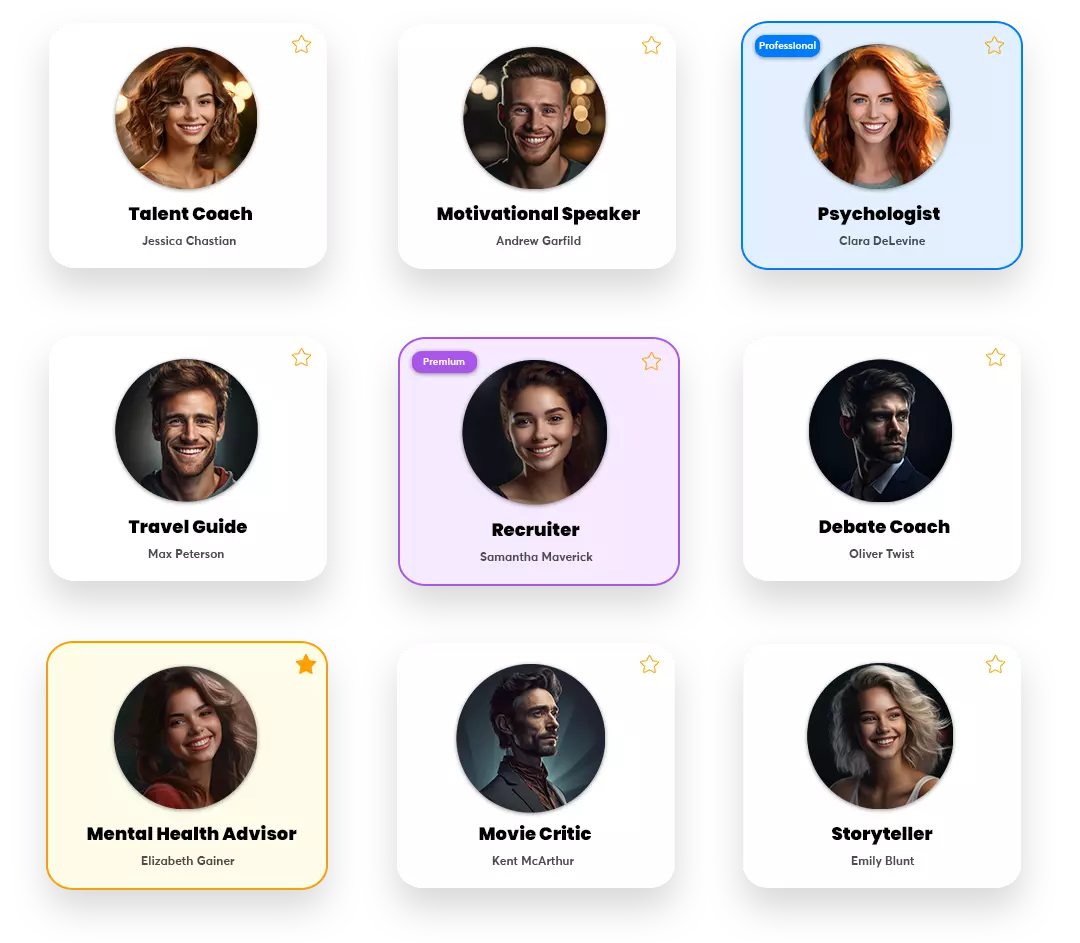
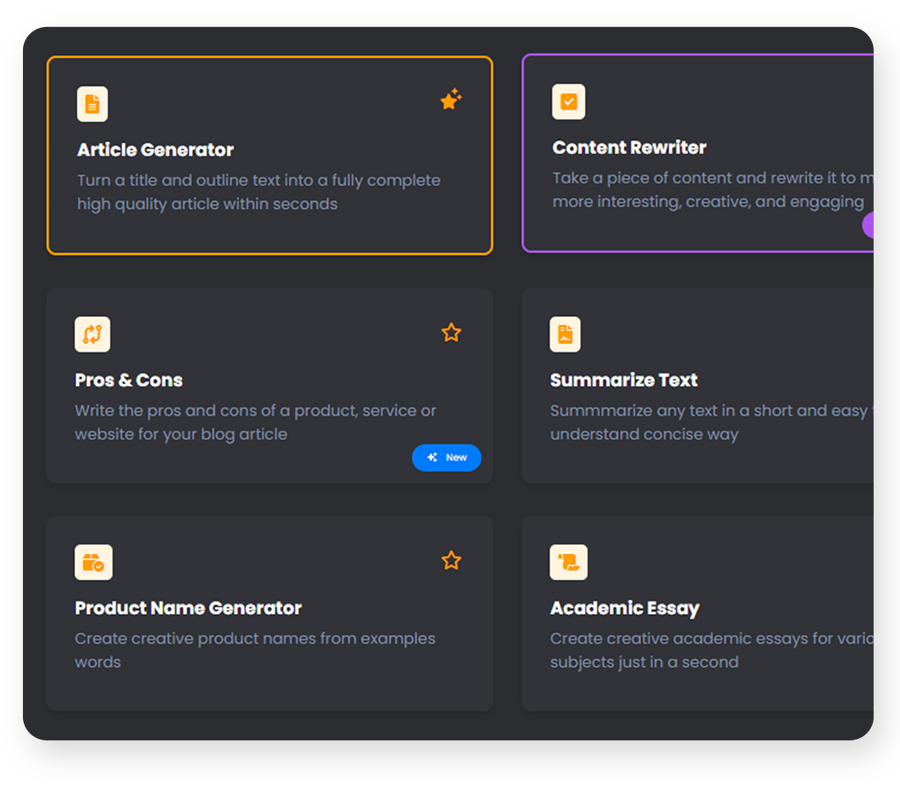

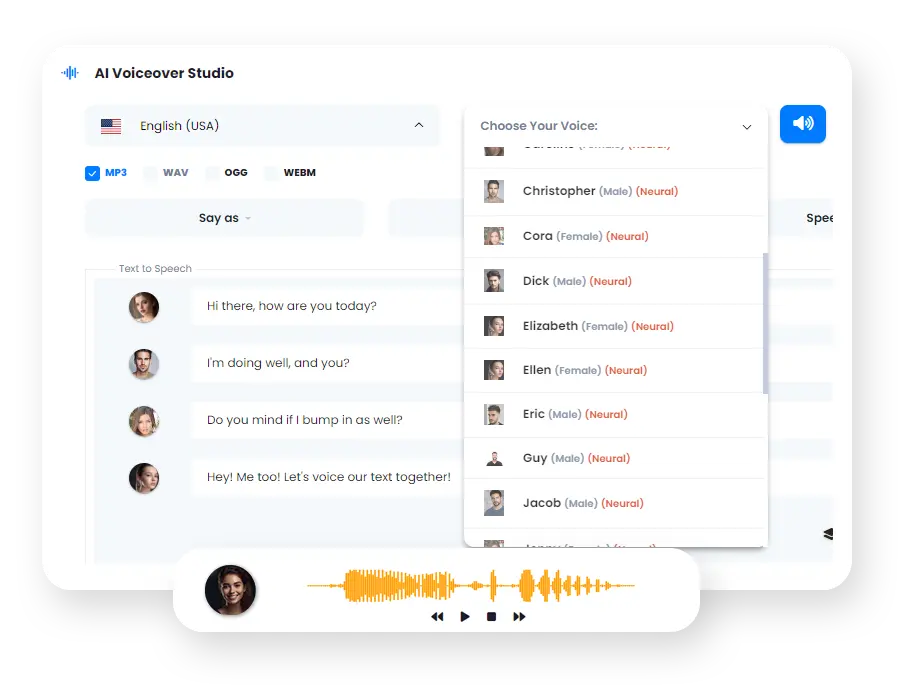
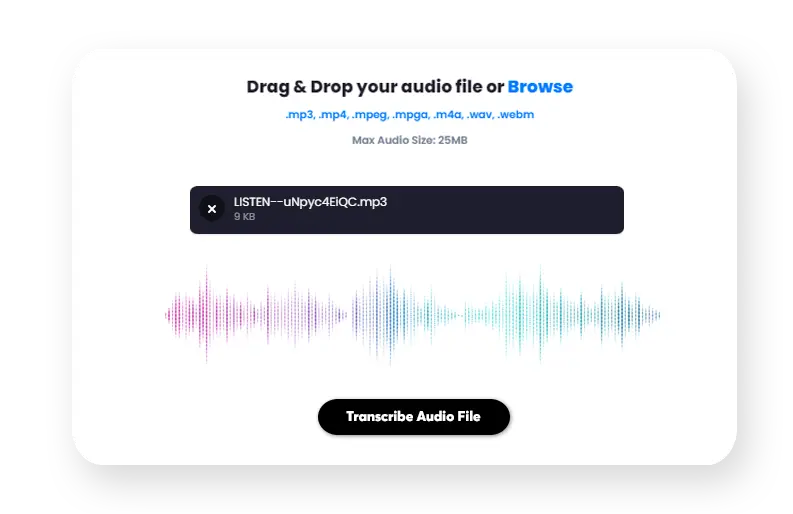
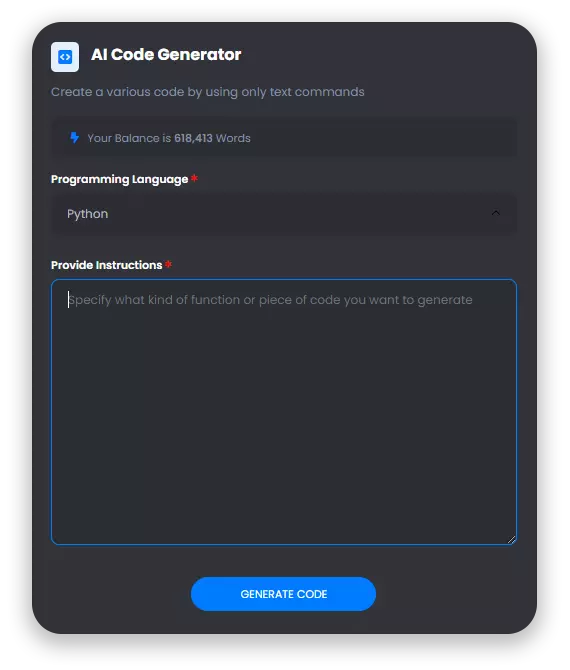




















Facebook Ads
Write Facebook ads that engage your audience and deliver a high conversion rate
Instagram Captions
Grab attention with catchy captions for your Instagram posts
Instagram Hashtags Generator
Find the best hashtags to use for your Instagram posts
Social Media Post (Personal)
Write a social media post for yourself to be published on any platform
Social Media Post (Business)
Write a post for your business to be published on any social media platform
Facebook Headlines
Write catchy and convincing headlines to make your Facebook Ads stand out
Google Ads Headlines
Write catchy 30-character headlines to promote your product with Google Ads
Google Ads Description
Write a Google Ads description that makes your ad stand out and generates leads
LinkedIn Posts
Create an interesting linkedin post with the help of AI
Twitter Tweets
Generate an interesting twitter tweets with AI
LinkedIn Ad Headlines
Attention-grabbing, click-inducing and high-converting ad headlines for LinkedIn
LinkedIn Ad Descriptions
Professional and eye-catching ad descriptions that will make your product shine